Tag Archives: airliner

747s Might Be Fading But Thai Is Still Playing

The passenger 747 fleet is something that is shrinking fast.  US operators have retired theirs but other operators still have fleets in use, some of which (like British Airways) are still fairly large.  However, they are definitely not as common a sight as they used to be and seeing one from a different operator is a nice surprise.  At Haneda I saw a couple of operators.  A Qantas jet was parked on the far side of the field and, while visible, wasn’t much of a shot.  However, a Thai Airways jet was on the gate when I arrived so it seemed like there was a fair chance it would move before I overheated and gave up.

It took a while but eventually it did push back and taxi for the runway I was watching.  It then sat at the hold for what seemed like a ridiculously long time.  It probably wasn’t that long but I was wilting in the heat and begging it to move.  Finally it did line up and got off the ground pretty quickly.  I guess the run to Thailand is not a long one so it wouldn’t have been very heavy.  I wonder whether I shall ever see one of these again?

Some Other Evening Arrivals While Waiting for Cathay

Earlier this year I went out to get the Cathay Pacific A350 arrival later in the evening when the light was still good due to the longer days in summer.  Of course, Cathay wasn’t the only airline coming in at that time.  Some of the regular visitors also were arriving and even using the inner runway that is often only used by the heavier jets.  Here are a few shots from the other arrivals in the nice light you can get late on a summer evening.

Trislander!

I have written on the blog about the family connection to Bembridge on the Isle of Wight.  Bembridge Airport was, for many years, the center of operations for Britten Norman – manufacturers of the Islander aircraft.  The Islander has been a very successful twin engine piston that can get into all sorts of strips around the world.  It remains in production in small numbers and can be found at remote strips all over the world.

It has a less well known sibling though.  When you want to increase the capacity, you need more power.  You could go for more powerful engines – or you could add a third.  Where to put it though?  How about at the top of the fin?  That is what led to the Trislander.  I used to see them a lot as a kid but now they are less common.  Aurigny operated them from the UK mainland to the Channel Islands until relatively recently but they have now been retired.  Duxford has received one of their planes so I was really happy to see it there.  I guess this is a plane that only a mother can love but there is something about it.  Apparently one used to be in the Pacific Northwest but hasn’t been seen for a few years.  I would love to see one fly again.

An MRJ Comes This Side of the Cascades

A lunchtime jaunt up to Everett was the result of ATS carrying out a test flight of a Janet 737.  I got to the field with a little time in hand and was looking on FlightRadar24 for the position of the inbound jet when I saw something orbiting north of me up near Concrete.  It turned out to be one of the Mitsubishi MRJ90 test aircraft.  It was flying a series of patterns up there.  Since they carry out the test flying from Moses Lake, I wasn’t so surprised.  More importantly, I figured that they would head back to base when they were done.

Imagine my surprise when the radio burst to life with their callsign setting up on the approach.  A Janet was worth the trip but the MRJ was truly a bonus.  I have only seen one before and that was a delivery flight from Japan to Moses Lake that staged through San Jose and was in the blog here.  I hoped it was a different jet, but wasn’t going to gripe if it wasn’t (and I was pretty sure it wasn’t based on recollection of the registration).

The jet hummed its way down the approach and landed in front of me (and a few others that either knew or had got similarly lucky).  It them taxied back and held in front of FHCAM.  There was a departing Embraer in front of it so I figured it was waiting for them.  However, they departed and it didn’t move for a while.  I needed to head back so was desperately hoping it would go soon.  Just as I was about to give up, they released the brakes and taxied to the hold.  The departure was pretty quiet with the Pratt GTFs not making much noise at all.

The original colors of the jet appear to have been overtaken by test markings.  There were some details around the engine inlets and the upper rear fuselage had been painted black.  I suspected this might be for testing of water ingestion to help visualize the water flow but if anyone knows better what the purpose is, please do let me know.

Korean Air’s Last 777

I’ve seen a few Korean Air 777s on test at Everett since we moved here.  This one was heading out on a delivery flight on a Friday evening.  The only reason it gets a post is that, from what I can discover, this is the last 777 that Korean Air has on order.  They have a bunch of 787s to come in the coming years but this is their last 777-300ER.  They haven’t ordered the 777X (which, given how many different widebody types they operate, is quite a surprise!).

Dropping the Shutter Speed in Bad Light

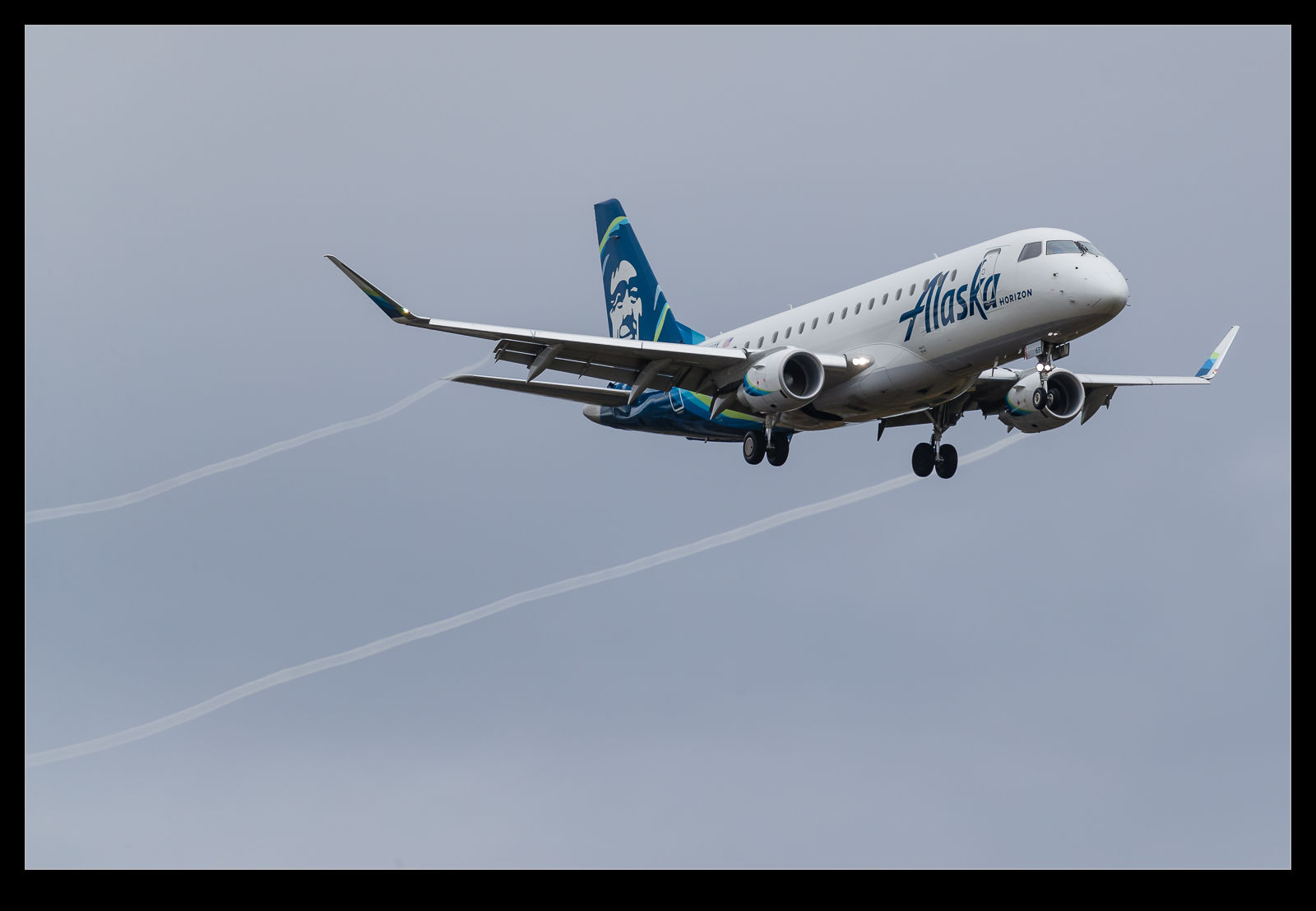
My cloudy Vancouver shoot also gave me the chance to play around with some lower shutter speeds.  I have done this for the turboprops before but this time I decided to play with some of the jets.  A really low shuttle speed can blur out the background and give a nice impression of movement but it is a problematic shot to make.  You don’t want to do it on something that you are keen to get in case you get nothing!  It is also something that results in very small apertures if there is much light which can make for a lot of dust spotting in post!  A cloudy evening is a good time to try and a bunch of boring regular jets are good targets for a trial!

FedEx Testing and Delivery

Summer evenings can be a good time to visit Paine Field as flying seems to be busy and the light is often quite nice.  On two separate visits, I saw this FedEx 777F flying.  The first time it was on some acceptance flights and it flew an approach followed by a low go around.  The gear doors had been blown down prior to this approach and the RAT was deployed.  It then flew a pattern and landed.

Next time I saw it, it was heading off to Memphis on its delivery flight.  They seemed to have a few issues with the transponder prior to departure which was fine for me as it delayed them until the light was a bit nicer.  Not sure I would be so happy to take my new plane with a snag though!  Memphis when empty is a piece of cake for a 777F so it made it off the ground pretty speedily.

Stacked Up the YVR Approach

Getting a good angle on jets lined up on the approach is a combination of luck with where you can stand and the timing of the arrivals to be in sequence when you can get them all together.  It is also a question of whether you have the right focal length to catch them together but not so much that one is out of frame.  I played with this a bit at YVR.  Sometimes there would be a jet on the parallel approach too but combining the lot was more luck than judgement.

777X Taxi Trials

I had a lucky break one evening when I headed up to Paine Field for one thing, only to discover that the 777-9 development airframe was undergoing taxi tests.  I got there to see it on the Boeing ramp with cooling fans running to cools the brakes.  I was worried that I may have missed all of the action but this was not the case.  They had two more taxi trials that they ran before wrapping up.  Each time they would have a brake cooling session with the fans.

The engines are a problem at the moment so they don’t have a flight clearance.  That means that the taxi trials will not get too fast.  High speed taxi trials require a flight clearance to be available should the aircraft get airborne by accident.  These were not going to do anything like that so no lifting the nose wheel.  Just accelerate down the runway, gather data points and apply the brakes.  I wrote a piece for GAR which is here that covered the trial and there is some video below which includes a head on view of the folding wingtips being lowered into the flight position.

Boeing 2707 Mockup

An online discussion I was involved in recently revolved around supersonic transports.  While the TU-144 and Concorde were the main focus, the Boeing 2707 also came up.  I had seen the front fuselage mockup of this when it was at the Hiller Museum in San Carlos.  I realized I didn’t have any good photos of it and was a touch annoyed.  Looking up the story of the mockup, I found it was now at the Museum of Flight Restoration Facility at Paine Field.

I hadn’t visited the facility since moving up here so figured a visit was in order.  The mockup is easily accessible in the main part of the hangar.  However, it is rather big and so only fits in with the nose section removed.  I had a chat with the docent and he advised that it was unlikely to be moved to the main museum building given the amount of space it takes up.  I assume it will stay where it is for the foreseeable future.  The rest of the mockup was destroyed long ago so it is great that this piece has survived as a relic of a long gone program.