Category Archives: Air Shows

Finally, I Get to See the Bronco Demo

Tony De Bruyn’s air show performances with the Rockwell OV-10 Bronco have been a feature of shows for many years but, with me having not lived in the UK for a chunk of that time, I have never seen home display. Therefore, I was rather pleased to see he was on the schedule for the RAF Cosford air show. The plane is an agile performer and so well suited to keeping it tight in front of the crowd.

The lighting at Cosford is not ideal and his display did take place when the sun had not come around. However, I did the best I could to get some reasonable shots of the show. He really threw the plane around nicely including some slow passes and some aeros. The sideslip approach was something to see and the rate of decent he achieved was something else.
Not sure when the next chance will come my way, but I do hope to get to photograph another of his displays – preferably in better light. An evening display would be really great to make the most of the Luftwaffe colours on the plane.
Vintage Harriers Pulled Out for the Show

The static displays at RAF Cosford’s air show included quite the variety of out of service types that are kept at Cosford for training purposes. This included the first generation of Harriers. A pair of Harrier GR3s were on one lineup while a Sea Harrier FA2 was on another. The sun was out on the GR3s which made their ‘80s camouflage look great. Funny how, after years of Harrier IIs in service, when I think of Harriers, it is still the GR3s and the SHARs that come to mind.

A Very Famous Chinook

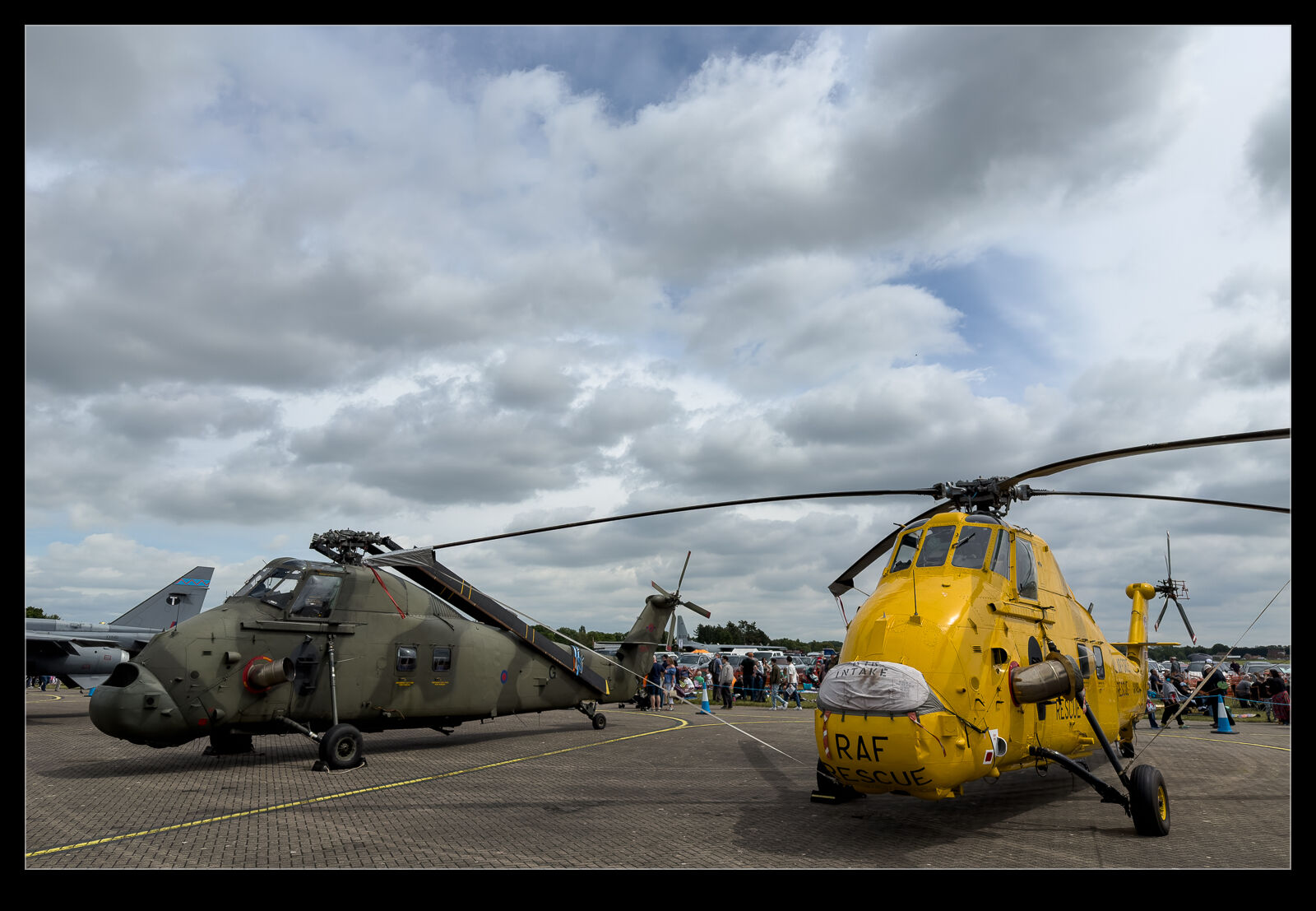
Parked in the static at RAF Cosford’s air show was a Chinook. Nothing too special, you might be forgiven for thinking. However, this is a Chinook with some history. Known broadly as Bravo November, despite having worn many markings over the years, this aircraft was delivered to the RAF in 1980. In 1982, it was one of four that went south to the Falklands on Atlantic Conveyor. It was the first to have its blades fitted and flew off the ship shortly before it was hit by an Exocet. The other three Chinooks went down with the ship.

As the sole Chinook with the task force, her lifting capacity was in high demand. There were missions when she was seriously overloaded compared to what the release to service might have said. Some rapid leaps forward were possible by carrying way more troops than would have been the case in peacetime. There was also one flight when the crew got too low and hit a lake. As they skimmed across the surface, water sprayed up towards the engines which began to spool down. A chunk of collective pulled them up and, without the water hitting them, the engines were able to come back up to power. Amazingly no serious damage was done, and she served throughout the remainder of the conflict.

The Falkland’s conflict was 1982 and there were then decades of service in all sorts of operations – both peacetime and conflict. Finally, the airframe has come to the end of its life and now it is on the ground at Cosford. Plenty of visitors were checking out this historic helicopter. Towards the end of the day, the sun came around nicely and it looked great.

Rafale Display

The Rafale has been in service for a long time now and exports have meant more countries operate it. I got to see some Indian Air Force examples when they came through Washington a couple of years ago. However, my experience of watching a display has been limited to the original Rafale A demonstrator and then the initial Rafale C development aircraft – both of which displayed at Farnborough. I have not seen a Rafale display since then.

This wasn’t the only reason I went to Cosford but it certainly was a big factor. The cancellation of RIAT had me thinking about what other air shows I might want to see and, while Cosford is not ideal from a lighting point of view with the crowd facing south-east, the knowledge that the French Air Force was bringing a Rafale to display was influential in my decision to go.

The display was excellent. I don’t know whether it is the characteristics of the aircraft and the nature of the display flying that the French Air Force goes for but this was an excellent show. (The French Mirage 2000 display always used to wow me too so there is a pattern.) The plane was constantly in motion and it really kept the attention of the crowd. There are definitely some lessons that other air forces could learn.

The display was just far enough into the show to get some benefit from the lighting coming around slightly. There was also some cloud which may have reduced the potential for silhouetting of the jet against the sky. I was a bit out of practice with my tracking but managed to get a few shots that I was happy with. I am not always in favour of special paint schemes for display jets but this one was no bad thing. I do hope to see the display again at some point – preferably in better lighting.


Catalina at RIAT

I had seen a few Catalina family aircraft in recent years living in the PNW. I was a little surprised by this one showing up at Fairford for RIAT last year. Sadly, I only got to see it on the ground as it taxied in after arriving. I don’t know when it departed and why I missed it, but such is life. Here are a few shots of it. The blister windows on the rear fuselage look a lot slicker than the original design!

The Sun Was Going Away Rapidly!

Last summer, the evening show at Old Warden included a flight by the de Havilland Comet. It was both in a formation and making some solo passes. The light had been absolutely excellent, but I was getting concerned that the light might be gone before it flew. The bright red paint has the potential to look excellent in very low angle sun, and I wanted to see that if possible.

It started out in a four-ship formation, and I was hoping that they would then do solo performances. Instead, the Comet ended up doing a series of formation passes with the Lysander. This was an interesting combination, but I was hoping to isolate it a bit. With a bit of luck and planning, I was able to get some individual shots that I liked. Sadly, the light was definitely on the way out by this time and, instead of having some gorgeous warmth on a red airframe, things were a little muted. Even so, not a bad thing to wrap up the air show.

Building a Temporary Landing Pad

On one of the arrival days for RIAT, I saw this crew pull up with a truck load of metal planking. They were laying out landing pads for some of the helicopters that were coming in for the show. The truck had a crane built in to allow them to lift the panels off and place them where needed. It was quite a quick process for them to build these pads. They did move some panels after placing them so it seemed like the process of taking it away afterwards would be similarly straightforward.

A Long Way to Salute!

The Royal Jordanian Air Force brought a C-130 Hercules to RIAT in 2025. The aircraft had some special markings on it but the thing that caught my attention when reviewing the images was the crew member on the top of the fuselage. It is not uncommon to have someone open the top hatch to watch proceedings as the crew taxies in. In this case, he was saluting as they turned off the runway and continued to do so for almost all of the time they were taxiing in. He did wave to the crowd a couple of time but, otherwise, he saluted all the way past us. A good effort on his part.

Qinetiq’s Attendees

Some of my previous RIAT visits have included a selection of aircraft from the Qinetiq fleet. In 2025 I only saw a pair of aircraft from them. One was a King Air while the other was an AW139. The King Air didn’t look too special other than the raspberry ripple paint job. The AW139, on the other hand, is a helicopter that I think looks really good at any time. The livery suits it well and the crew made a pretty sporty arrival. It was nice to see both of them. Maybe some more airframes would be good next time.

Old Warden Visitor Departures

While Old Warden’s shows provide a great selection of vintage aircraft, they are also available for visitors to fly in. As the show was wrapping up the afternoon session and waiting for the evening flying to commence, this was the opportunity for many of the light aircraft to head for home. They might not be as glamorous as some of the performers, but they were interesting in their own right and the conditions were great.

The converted Beech 18 was certainly something unusual, but a Grob motor glider is not something you see every day. However, the one I liked the most was possibly the most common airframe. A Piper PA-28 headed out. This is a type I used to fly many years ago. This one, though, was painted in British Caledonian colours and that really appealed to me having grown up with them flying out of Gatwick.