Tag Archives: military

Catalina at RIAT

I had seen a few Catalina family aircraft in recent years living in the PNW. I was a little surprised by this one showing up at Fairford for RIAT last year. Sadly, I only got to see it on the ground as it taxied in after arriving. I don’t know when it departed and why I missed it, but such is life. Here are a few shots of it. The blister windows on the rear fuselage look a lot slicker than the original design!

This is an Old Hornet!

This US Navy Hornet was rolling out at Nellis AFB during a Red Flag exercise. Looking at it now, it doesn’t have the antenna locations that the C model had so this must be an old A model. The US Navy has now retired all of its original Hornets (although the Marines haven’t relinquished all of theirs yet). However, when it took this, I think that the Navy was mainly using C models so this must have been on its last legs. I do love the look with the speedbrake deployed. There was a Charlie as well so I shall include that for fun.

Look at the Tailplane on the Bone

I have been looking back through a variety of shots from old visits to Red Flag exercises. Therefore, there is going to be a steady steam of Red Flag photos in the near future. Sorry if that gets a bit repetitive but I assure you that they will be different types on the whole. I start with the B-1B Lancer. This example was taxiing along the runway as it backtracked for departure. The pre-take off routine includes exercising the full range of travel for the tailplane and it really can move a long way. This shot showed it in the full nose up position.
Someone Having a Fun Ride in a Spitfire

I alluded to this post in a previous one. The Spitfire rides operating from Solent Airport take people up in a two seat Spitfire. I was down on the seafront at Lee on Solent when I heard the sound of a Merlin at power. I had almost every setting wrong on the camera but managed to switch to the right shutter speed and get the frame rate reset as it climbed out. This did take a bit of time and while the best top side view of it turning east were on display. Things were a bit more level but the time I got some shots off. Not idea but still okay. A while later, they returned from their trip, and we had a fly through along the runway alignment before they landed. I would like to plan better to be there in the future in a more planned way.

Visualise That Trailing Vortex

I was working through some images that I had taken on my one and only visit to Rainbow Canyon when the military was still flying through that part of region. One of the shots that caught my eye was this one of a Super Hornet. It had passed me and was heading down towards the valley. This involved a few tight pulls around the curves in the canyon. A strong trailing vortex changes the density of the air which affects the refractive index. This distortion of the light makes the vortex visible if only by impacting the view of whatever is behind it. A good view of that effect can be seen in this shot.
Stukas Are Rare as Hen’s Teeth

Given how many of them were built, it is surprising how few Stukas remain. There is one in restoration in Everett at FHCAM which is supposed to be intended to fly when it is complete. I saw that one at various times when still in Seattle. There is also one in the Museum of Science and Industry in Chicago. The RAF Museum at Hendon also has one and this is the one I saw most recently. Any others are wrecks that have been recovered. The shape of the Stuka is very distinctive. Footage of WWII so often includes them diving in on targets with the sound of the noise trumpet device that they could fit having become synonymous with aircraft diving. Not sure how many more of them I will ever see!

The Belvedere Looks Amazing

I am far too young to have seen the Bristol Belvedere in flight, despite what some might think! Given how old it is, it really does seem like quite a large helicopter to have been developed and operated. I bet it looked pretty cool when it was flying. Even now, when see in a museum, I think it is still quite a beast. The example at the RAF Museum in Hendon was there when I first visited in the late 80s and it is still on display. Getting shots of something this large in a relatively confined space is tricky but worthwhile. Do you think it looks as good as I do?

Peering Over the Fence at Bruntingthorpe

When we lived in the US, I would see lots of photos of people attending events at Bruntingthorpe with all sorts of vintage jets roaring down the runway. Sadly, those days are long gone. The story behind that is not one I know. However, there is still a collection of aircraft at the end of the airfield where I believe they have the QRA sheds with the Lightnings. One morning, I was driving north to Derby for work. I decided a small detour was allowable since it was early in the morning. I had no idea how much was visible from the gates and whether anything was open. Nothing was so I peered over the fence and took a few quick photos before continuing on my way. Everything was a bit cluttered from this angle but the lone Starfighter – while distant – did look particularly interesting. Maybe I shall visit properly one day.

Reunited With DA2

In September 1990, I started work at what was then British Aerospace at Warton in Lancashire. I was part of the aerodynamics department so couldn’t have been happier fresh out of an aeronautical engineering degree. The walk from our office to the staff canteen could be done along the road but, why do that when you can cut through the hangars. 2 Hangar was the easiest route and also happened to be the location where the front fuselages for the Eurofighter were being assembled.

The programme went through a reworking as the German government considered its continued role post the end of the Cold War, but it did end up continuing even if one of the prototypes was deleted and the others got renamed. The first two planes were P01 and P02 which were German and British respectively. They became DA1 and DA2. DA2 made its first flight while I was away on a project, but I got to see it fly shortly after I returned.

I then got to see it fly a lot over the coming years. Initially it was in a grey paint scheme but, when it had the pressure mapping sensors fitted, it was painted black overall. I recall there was a justification for this, but I always felt it was because the initial Rafale had been painted black and looked really cool.

Military aircraft prototypes don’t usually have a long life. Usually, the development programme means that they are quite different from the final article and so not a useful platform for continued development. As instrumented versions of the production aircraft come online, the prototypes are superfluous. That was the case for DA2, and it found its way into the RAF Museum’s collection at Hendon. It is suspended from the roof of one of the hangars. This makes for a dynamic pose rather than just standing on its gear. However, it is a bit more limiting from getting angles on it.

Thankfully, the museum has a couple of balconies at that end of the hangar that you can access so you can try a variety of different positions to get a shot. There is always a problem with a black painted aircraft when photographing it indoors. The light is a bit limited and the backgrounds are quite bright compared to the subject. Definitely some challenges with taking the images and then processing them to show what you want without making it look wrong. Then again, that’s part of the fun, I guess. It was fun being reunited with a plane that I haven’t seen for a very long time, and I am glad that it has found a home that means many people can get to enjoy it too.

A Spey with a Burner Grafted On

British defence projects have a bit of a reputation for trying something that will boost domestic content but that compromises overall performance. In fact, some civil aviation projects would probably fit that description. One such project was the procurement of the F-4 Phantom. To boost UK content, the J-79 engine that was used in all other variants was replaced by the Rolls Royce Spey. This engine made it into various civil and military aircraft over the years. For the Phantom, it needed an afterburner.

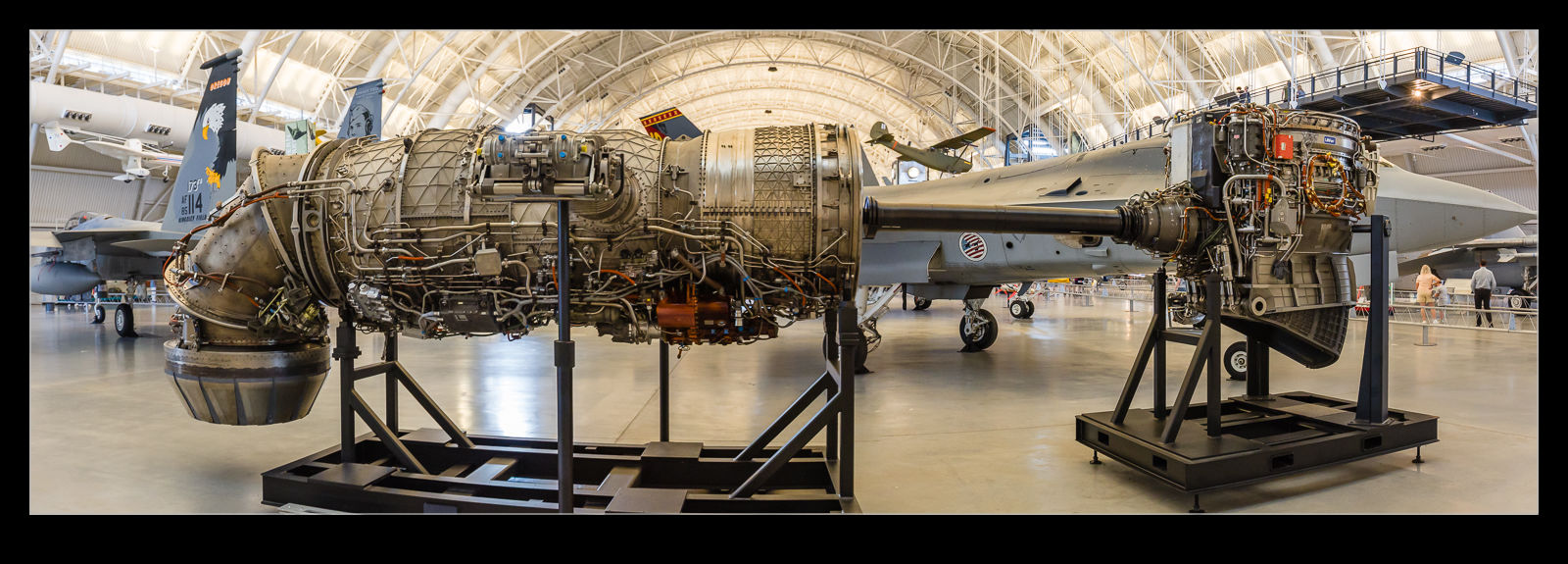
An example of the engine is on display at the RAF Museum in Hendon. I was first interested by the patterns of the flameholders in the afterburner so took some shots looking straight up the jet pipe. Then I moved around to the side. It is so easy to see where the original engine ends and where the added afterburner starts. It does not look like an integrated design whatsoever. It worked well enough although the redesign of the fuselage to accommodate it resulted in significantly increased drag. Top speed was reduced as was climb performance. One upside was that the Spey was a turbofan so, in the original ground attack role the Phantom had in the RAF, it actually improved low level fuel burn. It probably wasn’t so welcome once they moved across to the air defence role, though.