Tag Archives: aircraft

Finally, an Antonov Antonov

There have been quite a few appearances of Antonov AN124s on this blog.  They all have something in common.  They were operated by Volga Dnepr.  There is another operator that I have not had much success seeing.  That is Antonov Design Bureau.  They never seem to be operating near to me.  That was why I was so pleased when one was scheduled in to Everett.  I was taking a week off work anyway so no reason not to go.

The weather wasn’t great but how many chances would I get for an ADB AN124?  A genuine Antonov Antonov.  Time to go.  They were arriving from the north and it was morning so the only option was Future of Flight which wouldn’t normally be good for a morning flight.  However, with a grotty overcast, sun on the wrong side wasn’t going to be such a problem.

There was a bit of a breeze from our side of the runway so the early approach looked like they were coming straight for us.  They floated down the approach and touchdown of all of those wheels resulted in plenty of smoke.  Then they taxied back to the Boeing ramp (after some confusion with air traffic) and shut down.

P-3s Coming Out of the Sun

When Ault Field is operating on 25, the aircraft taxi out to the departure end along a taxiway that gradually brings them into view from the crash gate.  The sound will usually precede them and, in the case of the P-3s, that is a pretty distinctive sound.  As the day wears on, they are coming at you out of the sun so a bit more silhouetted but that helps to make them look more interesting.  They pull around to the hold point, sometimes mixing in with the Growlers before departing off to the west.  This is a sight that will soon be gone as the P-8s take over.
What Goes On These Pylons?

An older generation of Learjet was heading out from Boeing Field.  I almost ignored it but I got a few shots as it rotated and climbed out.  As it did so I noticed it had a pod on an underwing pylon.  A little further research shows it belongs to Phoenix Air.  Apparently, they have a few Learjets that have electronic gear fitted – sometimes on pylons and sometimes internally.  This pod appears to have dielectric elements front and rear so may well be an EW pod of some sort.  I wonder if anyone knows more about these guys and what they would be up to.

Finally a VLJ Makes It

About a decade ago, the very light jet was the hot idea.  Everyone seemed to have a design and they were bringing tons of investment in to make the planes and sell them in quantities and at prices that had previously been unthinkable.  As it turned out, there was a good reason why it had been unthinkable and the projects either never made it to production or made a few before bankruptcy followed (sometimes more than once).  Eclipse did better than most in making jets before they folded, later re-emerging in a slimmed down form.

Cirrus is one company that stuck with it and didn’t go bust.  It did benefit from a lot of Chinese investment and the fact it had a successful piston lineup to generate some income didn’t hurt.  Their approach was the SF50 Vision, a single engine jet.  It was a slightly unusual design but not a bad one and it has finally made it to certification and production.  This example is a regular at Boeing Field so maybe it lives there?

DoJ SAAB

Unmarked aircraft are conspicuous by their effort to be inconspicuous.  I saw this SAAB 2000 parked up at the Clay Lacy ramp and, before too long, it taxied out and departed kindly backtracking passed me in the process.  SAAB 2000s are not overly common anyway so that was the first thing to notice but, since it was completely white, I figured it might belong to someone not advertising their presence.  Sure enough, it belongs to the Department of Justice.  I wonder what it was doing here?

Low Level Departure by Learjet 31

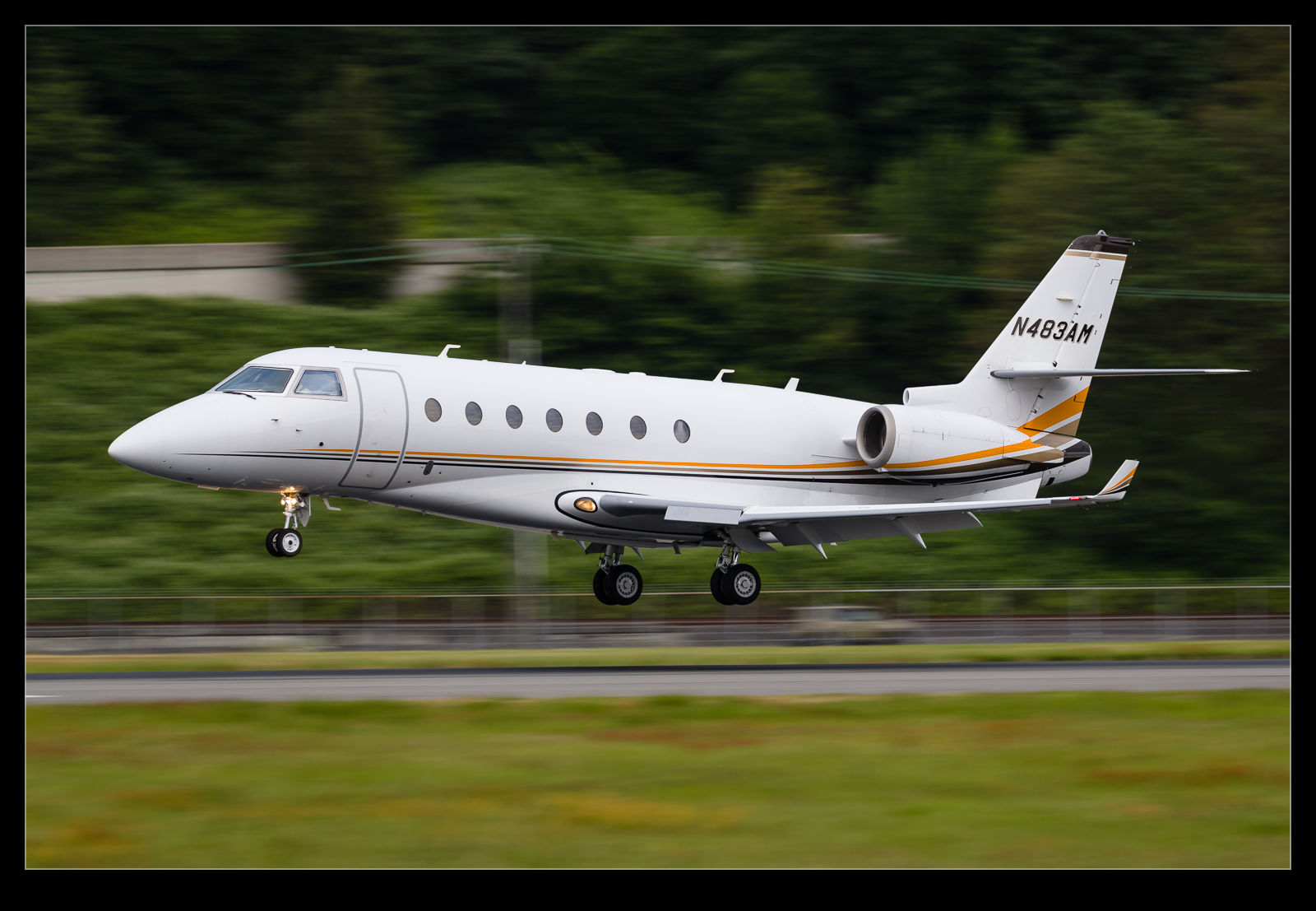
This Learjet 31 was heading out of Boeing Field on a lovely afternoon.  The pilot obviously liked a bit of speed because, after rotation, instead of climbing out, he kept it on the deck and built up some speed.  Then, as he got further along the runway, a more aggressive pull into a “zoom” climb.  I appreciated the effort because it meant the jet had some ground behind it as it came past which is a pleasant change.  The color scheme was pretty cool too.

Aussie P-8

With the progressive retirement of P-3 Orions around the world, the Boeing P-8 Poseidon is starting to take over as the dominant maritime patrol aircraft.  The US Navy is the principal customer, but Australia was relatively quick to order the type too.  They are now in the process of being delivered and I happened across one coming back to Boeing Field at the end of a test flight.  Since it was operating from their military ramp, it taxied back along the field after landing and right by giving me a good look at the configuration the Aussies have gone with.  India has been another customer and, before too long, the first of the RAF jets should make it through production.

More FCLP at Coupeville

My buddy Mark let me know that some more FCLP training was scheduled for Coupeville on a day with a good weather forecast.  Sadly, the wind suggested they would be operating in the opposite direction to that of my last visit (as discussed here and here) but there was the possibility of some morning flying which might mean the sun was on the right side for a while, even if a bit on the tail of the jets.  Unfortunately, the unit didn’t get the memo and they showed up in the middle of the day for the first round of flying so, while the conditions were okay, they were working against us.

Still, there are a lot worse things to do than watch Growlers bouncing through FCLP training.  You can move along the fence line at Coupeville to try and vary the angle, so Mark and I were zipping to and fro in order to try and find something different.  There are some bushes on the field that can be a touch inconvenient when looking to capture the moment of touchdown but a little experimentation and you could get a good result.

The jets appear to come through a tunnel in the trees as they are on final approach and the trees provide a nice backdrop for touchdown.  As they power up and away again, the light angles are most favorable so you can get a few good shots.  However, they end up pretty samey pretty quickly.

We expected a second batch of jets in the early afternoon so headed to the other side.  Here you are a lot further from the runway so the jets on the ground are rather distant and heat haze is a bit of a problem.  We got a few movements and then headed back to a nearby park where the jets tend to turn over the top of you as they enter the downwind.  The light is a bit better here but, again, the shots are pretty repetitive.  The only change is when the jet is done and it climbs straight out cleaning up as it goes.

With a decent amount of shots made, we decided it was time to try our luck elsewhere.  The Growlers would get back to Ault Field pretty quickly but we were going by car so it was a little longer for us.  However, there was much to justify the trip and that will be apparent in some upcoming posts.

One of the Early F-16s

The early versions of jets are often repurposed throughout their life.  They serve a role for testing but they are not configured like production jets and to make them so is too expensive to be worthwhile.  Besides, they are instrumented to some extent so they can be useful for carrying out alternate tests.  As a result, they often get used for trials, research tasks or development of alternate concepts.  The early F-16s did a lot of this sort of work and ended up in some odd programs like the AFTI effort.  Sitting outside at the Frontiers of Flight museum is one of these test aircraft.  It spent its life with General Dynamics (now Lockheed Martin) at Fort Worth and, once it was done with, it found a new home at the museum.  Compared to the average F-16, this jet will have had a lot of interesting experiences!

Max7 Number Two

The first Max7 test aircraft got a blog posting here but I have now seen the second in action too.  I think I first saw it on the ramp at Renton but I didn’t see the registration so can’t be sure.  Now it is engaged in testing and flying regularly out of Boeing Field.  It actually departed as I pulled up, so I only got to watch it rather than get a shot.  It was a bit overcast then anyway.

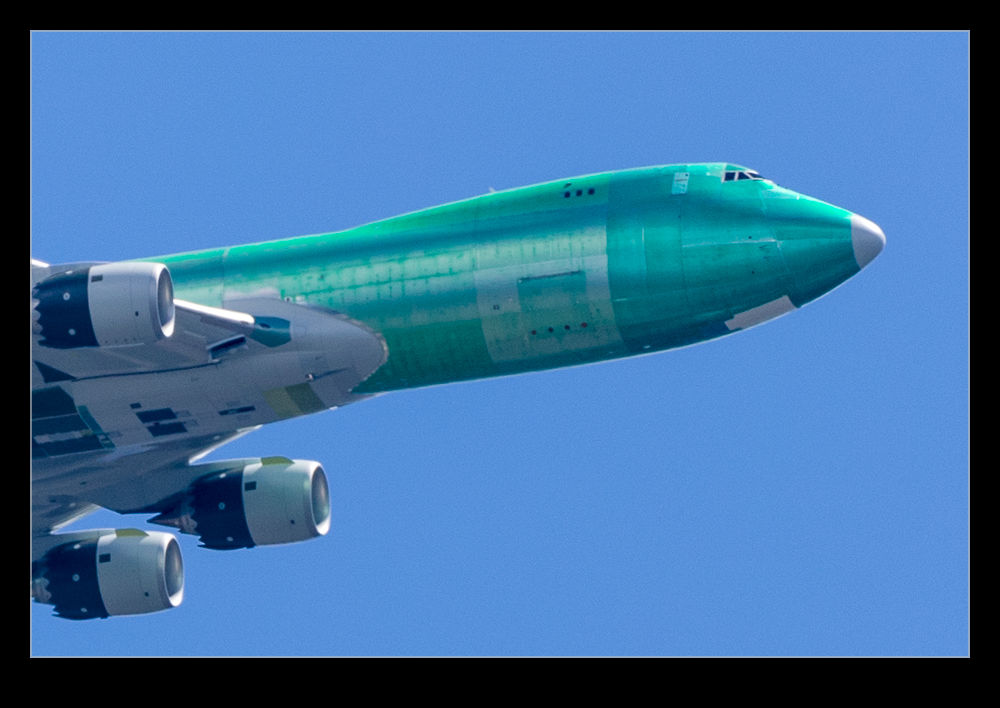
Later in the day it returned and this time the light was a lot more favorable.  I have yet to be able to gauge it against a 700 series and see the increase in length but the bigger engines are pretty obvious.  Still not a huge number of orders so we shall see whether it becomes a success but, in the meantime, we shall see them testing in the area for a while.