Reversed Operations at SFO

AU0E3613.jpgAn early morning start had me in Oakland looking for a shot that didn’t ending up working out the way I had anticipated. It didn’t take long to work out that I wasn’t going to be successful so I started looking for an alternative. It turned out that the winds were from a slightly unusual direction and SFO was running with operations in a different direction to normal. As a result, while I had been to SFO a few times in the previous month or so, I decided to head along.

AU0E3908.jpgNormally, the arrivals at SFO come in on the parallel 28 runways with departures of most jets from the 01s with the heavy jets going off the 28s in between the arrivals. With the wind switched around, most of the departures were coming off the 10s heading down the bay while the arrivals were coming across the bay from the Oakland direction to land on the 19s. In the morning, this meant the light was well placed on the nose of the departing jets and it also provided good illumination on the arriving jets. You also see them from an angle that is not normal at SFO.

AU0E3585.jpgGetting operations in these directions when the skies were clear and the temperatures cool enough to avoid too much in the way of heat haze was a combination I couldn’t pass up. Unfortunately, it wasn’t to last. While I could see jets out over the bay on their way in, some of the departing jets were starting to taxi around to the thresholds of the 01s. Sure enough, after the last of the landings, the departures started reverting to normal and the arrivals started to appear on the 28s. Not the end of the world but a shame that I didn’t get some more of the bigger jets departing from the 10s. They would have been cool to see given the favorable light.

Boris Bus

C59F0545.jpgMy years living and working in London were spent when the Routemaster was still a regular feature. As we left, the time was coming when the fleet would be retired and subsequent visits involved a more conventional selection of buses to get around the capital. (As an aside, when visiting London, use the bus rather than the tube. You see so much more and feel a lot more part of the city.). The days of jumping on and off moving buses seemed to be over.

C59F0548.jpgOur recent visit gave me my first view of the new buses that Boris Johnson wanted to replace the Routemaster. I am not very swayed by populist nostalgia and, aside from being able to get on and off when you liked, I felt the Routemaster had a lot of shortcomings as a passenger. However, I was curious as to whether the replacement was good or not. Boris’s hatred of the articulated buses struck me as utter bollocks. Sadly, we didn’t take any routes that used them. We did see a lot of them though. Interestingly, the rear platform was often closed off when I saw them. I guess that is only open on certain routes or in certain areas? Maybe someone could fill me in on that. They look a little strange but I imagine you become accustomed to them quickly enough. It will be interesting to see whether they come to dominate or end up as a diversion that ultimately goes away.

Another 747 Operator Bites the Dust

QB5Y1360.jpg There is a steady stream of Boeing 747 fleet retirements right now.  This month another one occurred when the last Air France 747 flight took place.  I have not seen a huge number of their Jumbos over the years but they have cropped up from time to time.  It turns out that the best shots I have got have all been at SFO although these were mainly taken long before I moved here.

QB5Y0652.jpgAnyway, farewell Air France 747s.  I wonder which operator will be next?

QB5Y0657.jpgC59F5539.jpg

Lick Observatory

AU0E3511.jpgHead southeast from San Jose and the terrain heads sharply up. Mount Hamilton sits ahead of you and, if you want to take the 18 mile trip up the mountain, you will arrive at the Lick Observatory. Operated by the University of California, there are many different telescopes in use. Visitors are welcome to see two of the telescopes.

C59F7649.jpgAt one time, the top of the mountain was home to quite a community including a school for the children of the staff. However, as the observations are now able to be made and controlled remotely, there is no need for the science teams to live up on the mountain. They make trips up for initial testing of instruments when they can stay in dormitories. However, once things are up and running, they can head back down the mountain. Consequently, the residents are now the maintenance and engineering staff. This means there is a far smaller number of people up on the summit most of the time.

AU0E3505.jpgThe view from the summit is very cool. We had a bit of haze in the air which limited things a little but the view down to San Jose and off to the Bay is impressive. It would have been nice to have been up there a day or so before when the skies were very clear. However, they also get some snow up there so it might have been a trickier drive up.

Interesting Raptor Control Inputs

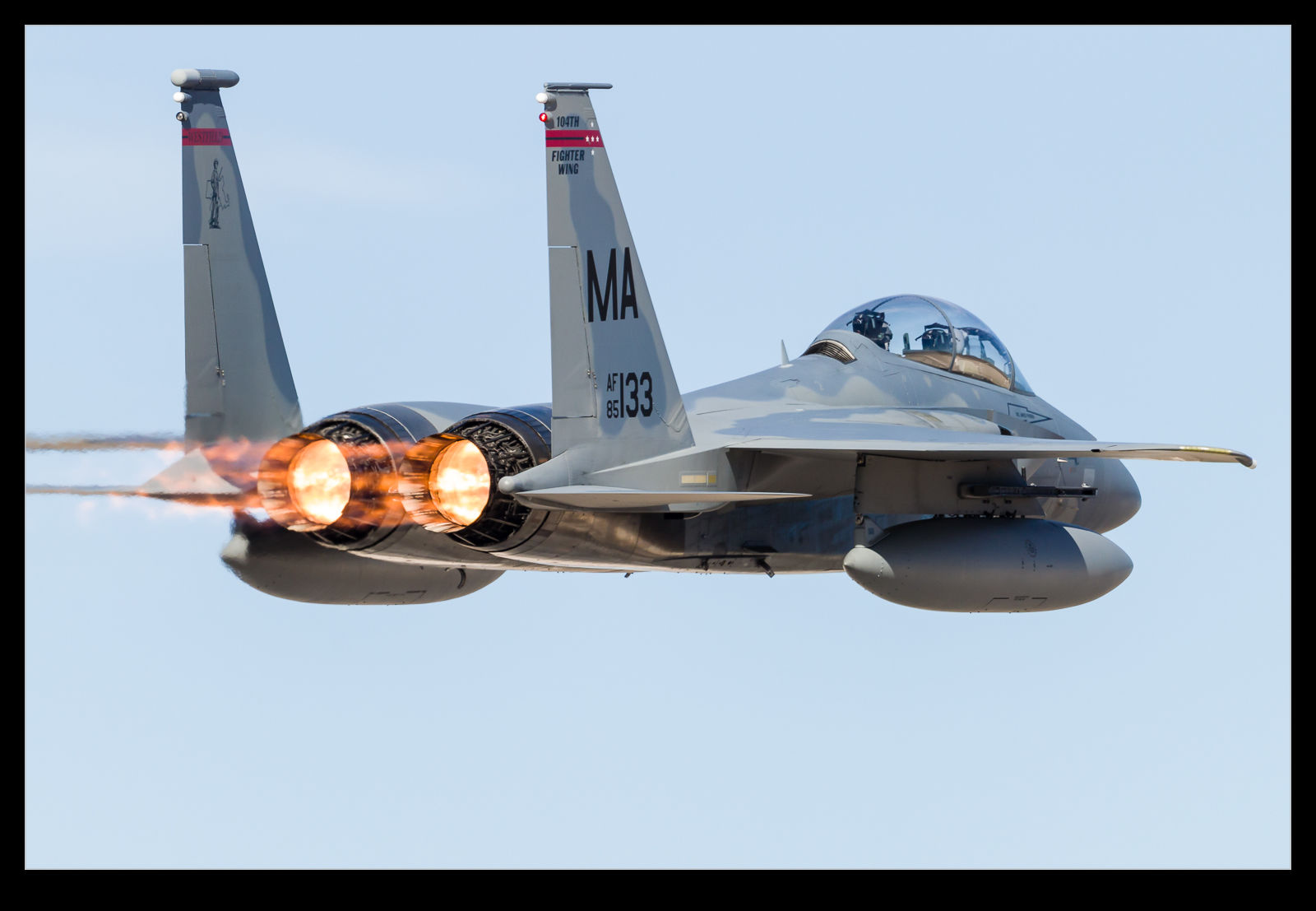
C59F1416.jpgIt might be a long time ago that I did anything closely related to the engineering of fighters but there is still a part of me that is a stability and control type of guy. Watching the control inputs and responses of planes is cool as far as I am concerned. With the advent of fly by wire designs, there was considerable scope to play around with the use of the control surfaces to achieve different aims. With no direct linkages to the stick, the pilot can be totally unaware of the choices the system is making for control combinations.

C59F1422.jpgThe engineers may have chosen to program the trailing edges to have different deflections inboard and outboard to offload the outer portion of the wing for example. The F-22 makes use of a variety of interesting control inputs. For example, it doesn’t have a traditional speed brake. I assume this was removed for stealth reasons. Instead, the control surfaces move counter to each other. You may have inboard flaps going down and outboard flaps going up. The moments cancel out but all increase drag incrementally so the effect is like having a speed brake deployed.

Since the aircraft is also unstable, you may have tail deflections that seem at odds with the maneuver being flown. During the Chino show, the usual routine was flown (usual for an F-22 but not many other jets) and, as I look through a bunch of the shots, I see some quite unusual control inputs. If you are in to such things, these may appeal to you. Gary, are you reading this?

Windy Day at SFO

AU0E8838.jpgThe winter brings days with clear skies and nice light angles. That is not all it brings, though. It can mean strong winds. One of my visits to SFO last year coincided with some very strong winds. The wind was gusting over 40kts on a regular basis. This was far to strong to allow operations on all of the runways. With the wind almost directly down the 28s, those runways were in use for arrivals and departures.

AU0E9796.jpgThe wind might have been strong but the conditions weren’t bad for photography. The sun was actually out and the light on the planes was pretty nice. However, using a long lens was a bit more tricky with the wind since it tended to blow the lens around a lot. I spent a lot of time trying to stay in the lee of a tree to shield myself from the worst of the gusts.

AU0E9424.jpgConsolidation of all operations on the two runways meant that things could get pretty congested near the thresholds. Plenty of jets were lined up ready for departure in between the arrivals. Having so many jets up there is relatively unusual. It is a bit problematic for some shots though. The arriving jets are behind those awaiting departure slots. The waiting jets produce a lot of distortion from the heat of their engine exhausts. This can be quite frustrating since the number of jets means that clear space for a shot is limited.

AU0E9118.jpgThere are more benefits of course. Having very strong winds straight down the runway means the departing jets have a big advantage. Nearly 40kts on your ASI while standing still means a lot less ground roll is needed to get airborne. The narrow bodies were jumping into the air long before they got off peninsula extending the runways out into the bay. The same was true for the wide bodies. The heavy 747s always have a longer roll but they were getting up before the cross runways. The big twins were getting up very quickly. I had a pretty good view of the 777s as they departed and got what is probably my clearest view yet of the truck rotation on the 777-300ERs – a quest familiar to the regular readers.
AU0E9548.jpgFighting the wind made for a tiring day. I decided I would wait around until the Virgin 787-9 showed up and then call it quits. This was due to be one of the last big arrivals prior to the sun disappearing. When it came in, the light was very nice. I got some good shots and then packed up to go. Going back through the shots since, it was quite clear that the wind was a big factor in my shooting. The sharpness of some shots suffered but the bigger issue was tracking accurately. Far to many extremities of planes got chopped off. Despite, that, the opportunities a day like that offers made it well worth doing and I would be back in a heartbeat if the conditions come together.
AU0E9926.jpg

Hovertravel Have a Busy Day

C59F1565.jpgAnother Isle of Wight development is the hovercraft. Much early development of the concept was done on the Island and many were produced in East Cowes. Hovertravel still provide a frequent service between Ryde on the Island and Southsea on the mainland. I got a couple of opportunities to shoot these hovercraft while visiting. On the day Pete and I went flying, we arrived over Ryde just as one of the hovercraft was coming in. Another was parked on the slipway at the time.

C59F1398.jpgWhen we left the island, I headed up on the upper deck of the ferry to see what was going on and had two over the hovercraft come by in opposite directions. It was rather windy up on deck but I was able to get some usable shots of the two of them individually and as they crossed. Apparently, Hovertravel are in the process of acquiring new craft to replace the current AP1-88s that are in service. Given that they were built in the late 1980s, they have provided good service. It will be interesting to see what replaces them. I wonder whether the new vehicles will arrive before I next get back.

Coin Tree

C59F2066.jpgI’m not sure whether to categorize this as in interesting oddity or vandalism. While walking in the Lakes, we came across this tree. At a distance I thought it was an interesting type of bark but, once you get closer, it is clear that the tree has coins jammed into the surface. I have no idea how or when this started or even why it did. Obviously, a lot of people have jumped on the bandwagon and now there are so many coins embedded in the wood that I couldn’t see the point of even trying to estimate how many there were. Instead, we just checked the whole thing out and then went on our way.

C59F2067.jpg

Ripples in the Skin

AU0E4290.jpgThe construction technique for aluminum aircraft fuselages is known as semi-monocoque. A monocoque structure takes the entire load through the shell of the structure. In airframes, the skin is very thin and so frames and longerons are joined to the inside to provide additional rigidity while the skin still takes a lot of the load. If you haven’t ever seen the cross section of an aircraft structure, you may be surprised to see just how thin the skin panels actually are. They are perfectly up to the task of pressurization and bending loads so no need to panic.

AU0E4488.jpgAn outcome of this design approach is that the panels between the frames and longerons can experience some load directions that induce a measure of buckling. Nothing that is beyond their elastic limits but something that can be apparent if the light comes from the right angle. The lower side of the rear fuselage of the Boeing 757 is an area that is susceptible to this in certain flight conditions. I saw a number of them recently – both -200 and -300 models – and they both were showing visible distortion of the panels. The sun angle meant that the shadowing of these areas was apparent.

AU0E9169.jpgThe 757 is by no means the only aircraft to experience this phenomenon. The B-52 Superfortresss is a jet that shows this effect on plenty of occasions. I have heard people comment on it being a function of the age of the airframes but it is more of a result of the design of the basic structure than anything else. Certainly nothing to be immediately concerned about.