I posted photos of Donner Lake a while back as I was traversing the Sierras en route to Reno. This time we got a lot longer to look around. We did stop at the overlook on the interstate but then we dropped down the hill to the lake itself. There was a nice beach at one end which had a few people visiting even though it was rather early in the year. Some of the houses built along the lake looked pretty nice too. I imagine they would be very pleasant places to spend some relaxing time.
French Gazelle
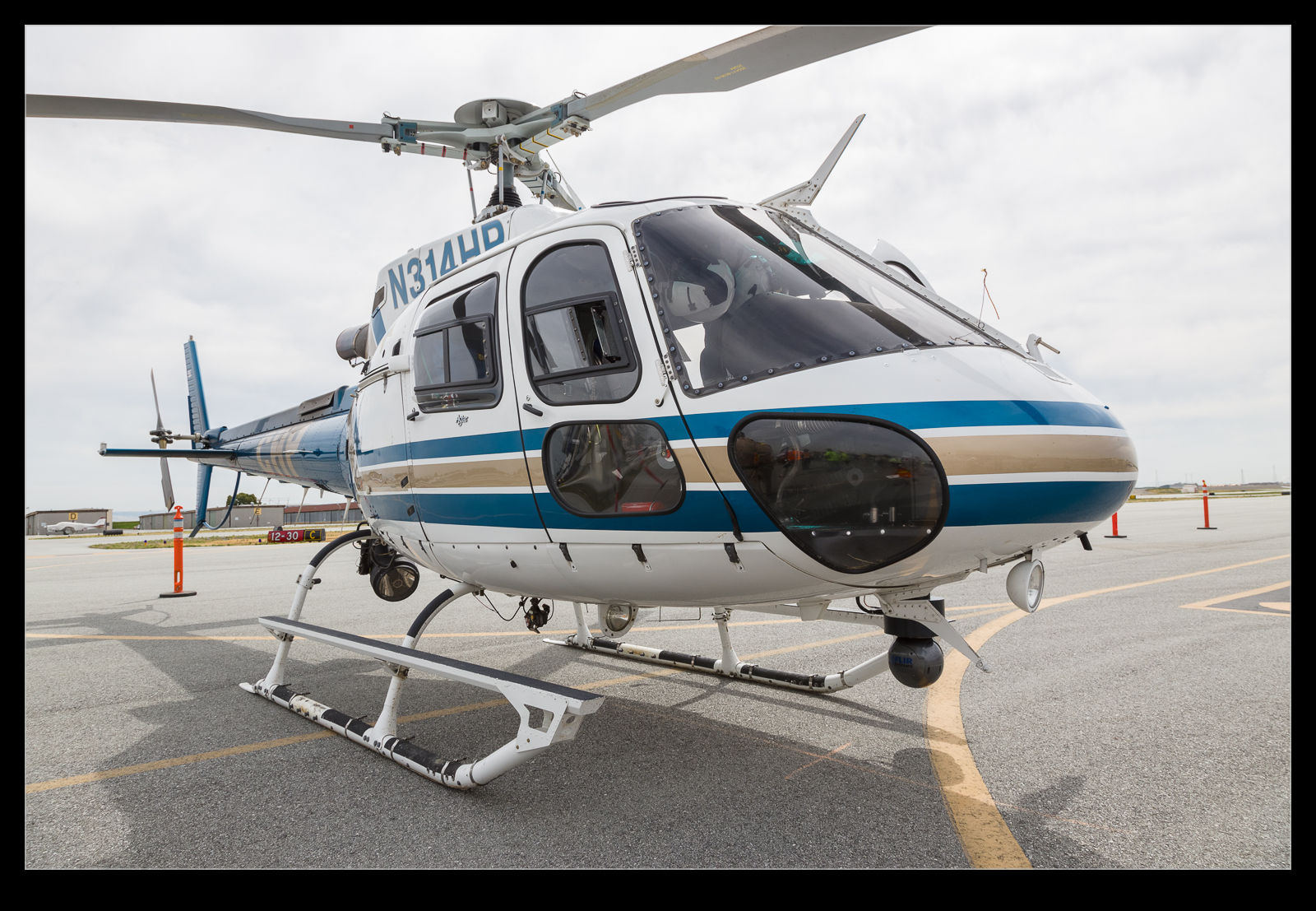
Chino is full of surprises. There are many hangars and many unusual things contained in them. A friend showed me a shot of a Jaguar T4 that was in one of them – I was disappointed to not see that myself. As I was walking back towards the parking with a fellow shooter, we came across a hangar with a Gazelle in it. The guy cleaning out the hangar floor invited us in. It was a French Army Gazelle, still equipped with many electronic boxes from its military role and showing the mounting point on the side of the fuselage where HOT anti-tank missiles were once mounted. He flies it regularly and says it has been immaculately maintained over its service life. It certainly looks great.
Squaw Creek in Full Flow
Squaw Valley has a river running through it. This river goes by the name of Squaw Creek – you wouldn’t have guessed would you? It is a short walk from the center of the resort to get to a series of falls that the creek goes over. A trail winds its way up into the hills a lot further if you are feeling energetic taking you to a lake (if it is early enough in the year for it not to have dried up). We didn’t explore all of this. It was the falls that were of interest.
The water was flowing quite nicely with the meltwater run off from the mountains. It would split around obstacles and take various paths down the hill but ending up together again as it descended. The falls were in some nice tree cover so it was a cool temperature as you climbed up the trail.
Rolls’ Testbed Flies While I Am There – Twice!
On my previous visit to Tucson, I saw the Rolls Royce owned Boeing 747 engine testbed. This was converted for the Boeing 787 Trent engine development program (hence the registration N787RR). The Number Two engine was removed and replaced with the test engine. The other three Rolls RB211s are unchanged. At various times the testbed has been reported to be without an engine in the test location but there was something there when I was last here – it’s just they didn’t fly. This time was different.
I saw the testbed when I left the airport after my flight landed. The following morning, I headed out to see what F-16 traffic there was and saw online that a flight plan had been filed for the testbed. I only had a certain amount of time before I was due to be at Hawgsmoke but it was supposed to fly long before that. Of course, test flying is not usually something that happens to a tight schedule and the takeoff time came and went. We were beginning to think we might miss it when the sound of some large engines spooling up reached us. A while later, out she came.
Engine testbeds require some careful control. Since one engine is significantly different in thrust from the others, there is a balancing act required to keep the thrust differential within the ability of the control surfaces to overcome. That means the max thrust is not always going to be used. Consequently, they use a good portion of the runway for takeoff rotating just passed our location. That meant I didn’t get the front quarter rotation shot I had in mind.
No matter, I still got to see it fly. The return was about six hours later and I was busy elsewhere at that time. I figured that was it for this trip. I was wrong. The morning of my departure, I had a little time to spare so went back to see what was happening. Amazingly, the testbed was already being crewed as I drove up. We got a repeat of the previous day and some similar shots. I guess I was compensating for not seeing it fly last time!
Squaw Valley Olympic Village
Ski resorts are designed around the winter season and, come the summer, they can often be rather deserted. The weather was warm and sunny during our visit to Squaw Valley Olympic Village but the place was far from quiet. There was a festival underway so the center of the resort was filled with stalls from various vendors selling all sorts of things but mainly focused on art and craft type items. Meanwhile, bands were playing at a couple of stages.
The event was obviously very popular and large numbers of people were milling about. Some of the lifts up the mountains were also still in use. Obviously a lot has changed since the days of the Winter Olympics in the 60s but there are still signs around the town of the history of the games having been there. I imagine the winter games were a lot lower key in those days but I still imagine the valley was pretty busy at that time. It would have been quite an influx of people. I wonder what the evening entertainment was like then.
Departure of Solar Impulse
Having been to Moffett Field for the arrival of Solar Impulse and then made another visit to the hangar while they were there, I wasn’t going to miss the departure. This might not seem like a difficult decision to make but if I tell you I had been away in Southern California for the weekend and having driven back on Sunday and then finding out that departure was scheduled for 5am on Monday and we would be required to get there at 2am and I would need to be up at 1am, you can see why this was a bit tougher to do.
However, I was committed at this point (or should have been) so I slept in the spare room so as to not disturb Nancy. Off for an early run. Traffic was no problem at that time as your might imagine. Once there it was back to the same issues as we had faced with the arrival. It was very dark. Hayman did the stills and I went for video but got some stills as well. Unfortunately, they chose not to back-track the aircraft as had been briefed so it took off from ahead of us and went away. We still got some good shots and, while it got airborne very quickly, it got to a certain distance when it seemed like it had stopped moving.
Then, it was time to go. We wrapped up and got on our way. I actually was back at home a little ahead of my normal time to get up so I did my normal routine and headed in to the office. It would be fair to say that I was not at my most perky that day!
Sunset on the Aquarium
I have been to the aquarium at Monterey a few times and those trips have made their way on to this blog before. The whale watching trip with Monterey Bay Whale Watch headed back to the marina in the early evening and provided a view of the aquarium that I haven’t seen before. The evening light looked very nice on the old structure.
Mustang Motion
The Society of Aviation History visit to Airmotive Specialties in Salinas gave us a great opportunity to look around the restoration facility. One of the Mustangs was not being worked on though. It was due to be picked up by its owner that afternoon. As a result, having had a break for lunch, we headed back to the ramp to await the departure.
The aircraft was run up on the ramp outside the hangar and then taxied to the opposite end of the runway for takeoff. We anticipated the takeoff and then a further pass before he left. I figured the first time I might go with a slow shutter speed for fun. The second one I would be a bit more conservative in order to make sure I actually got a sharp shot.
After the two passes the aircraft headed off en route. Getting a bit of airborne Mustang time was a cool addition to a great day.
Truckee
Prior to visiting Truckee, I knew virtually nothing about it. I knew some people who had visited and liked it but I knew not much at all other than that it was a station on the railroad over the Sierras. It turns out to be a great little town. The main street provides a lot to see and do on a day out. The variety of buildings is interesting and there is a nice map you can pick up at the visitors’ center that explains the history of various places and the background to the town itself. It has gone through a number of phases as the economy of the area has developed.
The Truckee Hotel looks very cool. A colleague of mine stayed there a couple of years ago and had a great time. A gas station has been restored and used as office space but it looks just like an operational gas station still. The train depot includes the visitors’ center along with the Amtrak station. There are plenty of places to eat and a good selection of shops with arts, crafts and other items. We walked the length of the town and checked out the various buildings. The street runs alongside the river and there is some more on the other side although not as much to attract your attention. The town is not all though. There is more in the vicinity for another post. This would not be our only visit to the town on this trip either.
Marineflieger Tornado
Tornado was a tri-national program. The UK, Germany and Italy were the partners that developed and produced the aircraft. There was only one export customer which was Saudi Arabia. All of the users continue to operate the aircraft although all of the ADVs have now been withdrawn. Germany took a substantial number of the jets but, while the Luftwaffe remains a major user, it is easy to forget that they were not alone.
The German Navy had a fast jet fleet. The Marineflieger operated the F-104 in large numbers and these were replaced by the Tornado. Originally, they were in the Blue/gray upper fuselage with white undersides colors which looked very neat. Later on (including the time this photo was taken), they had migrated to a camouflage scheme. Then, a consolidation exercise took place and the Navy jets were transferred to the Luftwaffe which took over their responsibilities.