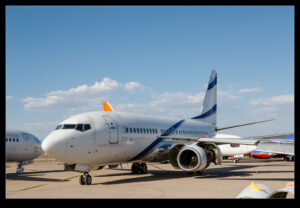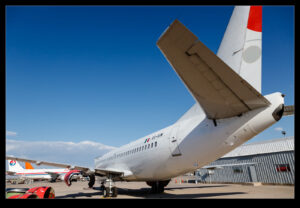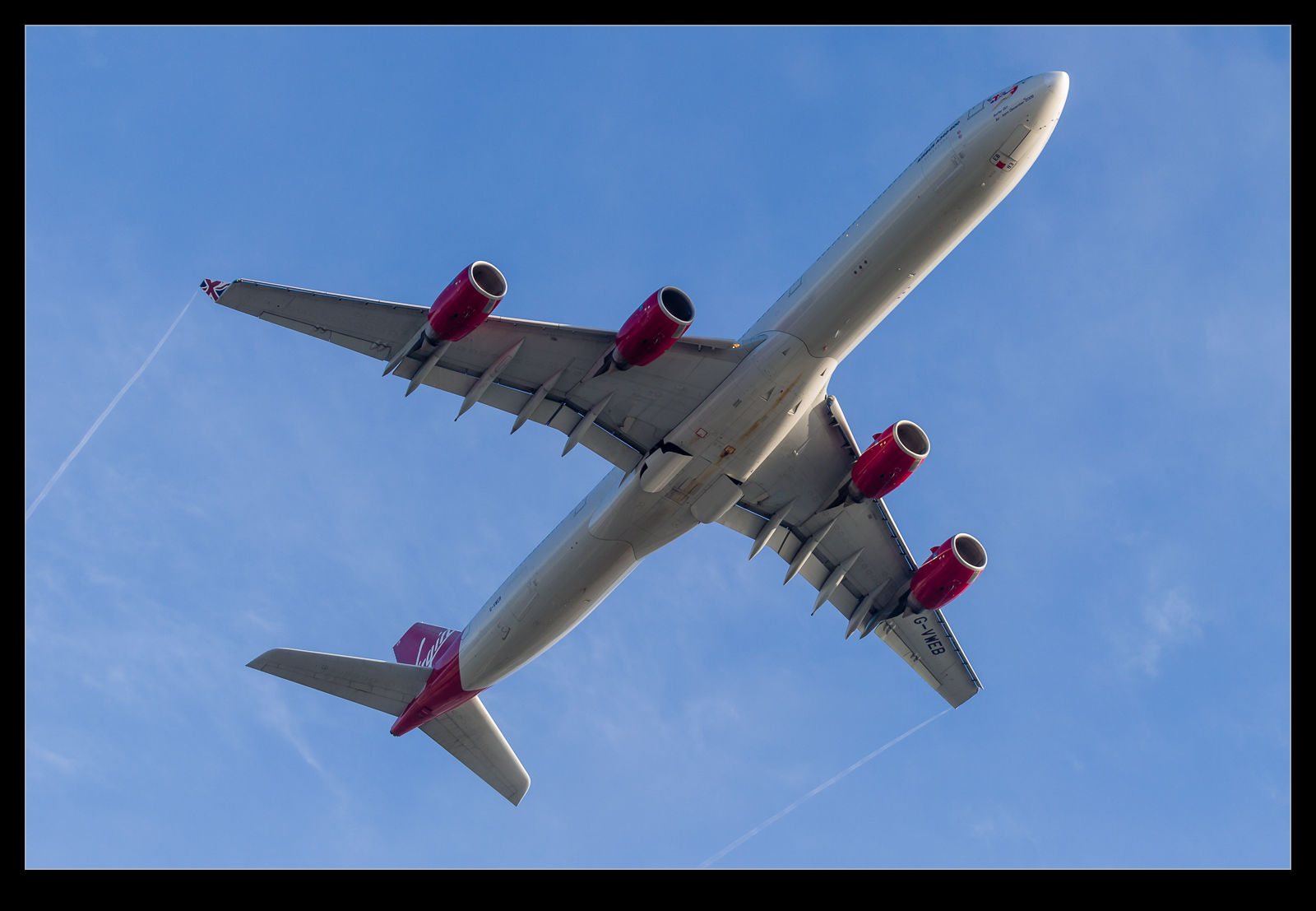
There is not a huge amount of variation in airliners these days so coming across something a little different is usually a moment of interest. While the name Alaska Airlines might suggest an airline focused on Alaska, it is actually headquartered in Seattle and seems to have a wide range of operations all across the west coast. Consequently, we see a lot of them in both Oakland and SFO. They have a large fleet of 737-800s and 737-900ERs and both types have been retrofitted with the APB Scimitar winglets. Apparently, not all of them though. This example I saw coming by Coyote Point and it not only doesn’t have Scimitars, it doesn’t have winglets at all. A rare beast these days.
Tag Archives: jet
Night Loading the Ruslan
Waiting on the ramp at Moffett Field for Solar Impulse, over on the other side of the field we could see another visitor. An Antonov AN124 Ruslan was parked up with its nosed raised in the process of loading a payload. It looked a bit like a satellite container and, given the proximity of two satellite manufacturers, that wouldn’t be improbable. It was a long way off but I had some time to try and get a shot and this was what I got.
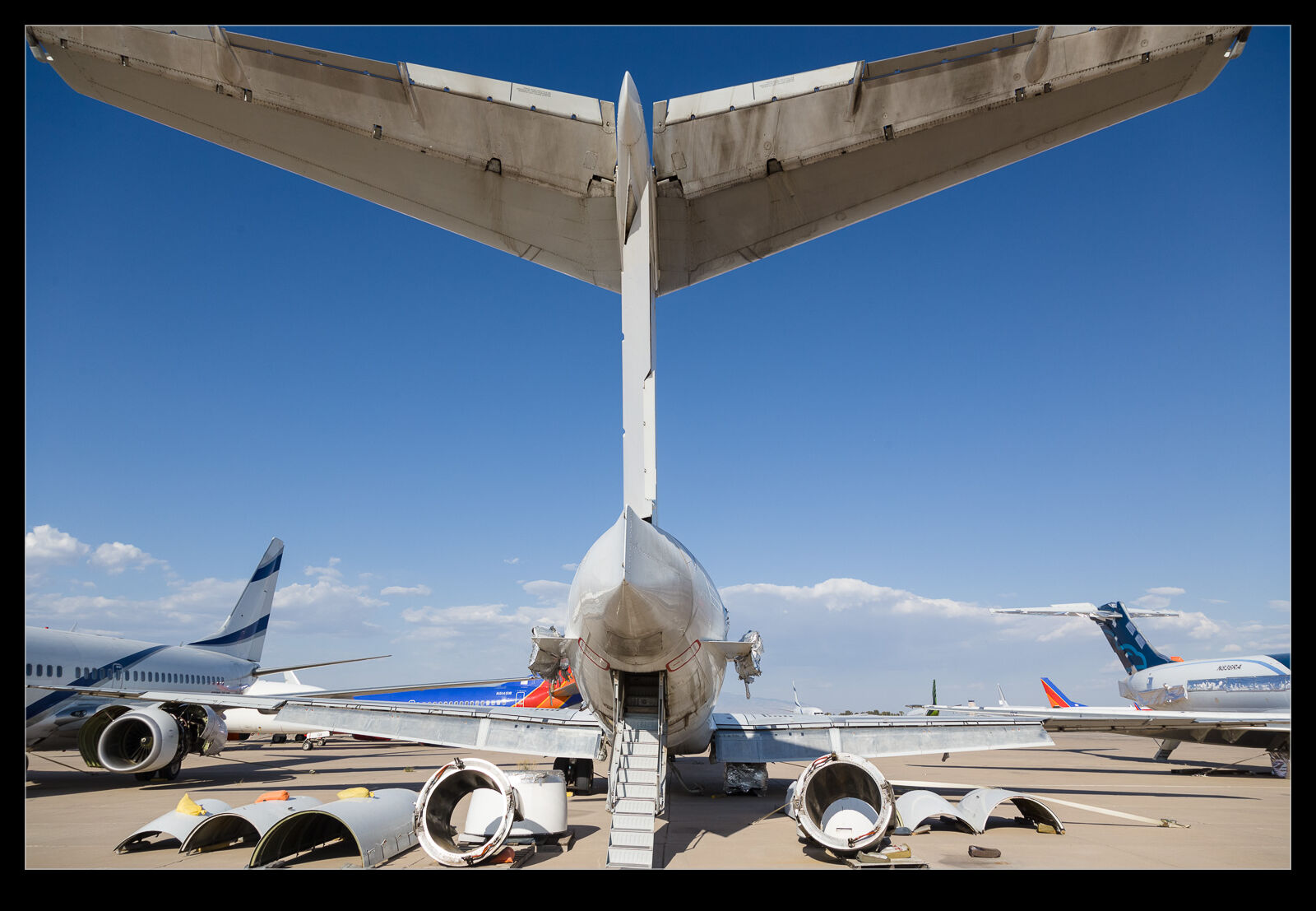
The Camera Might See But Autofocus Doesn’t
And I could barely see much myself! We were on the ramp at Moffett Field for the arrival of Solar Impulse. There was some time to wait while we were out there. As I looked around, I thought I could see something parked further down the ramp. There was very little light but there appeared to be some aircraft. I figured it was worth a look given that I had a tripod.
In the days of film shooting, I couldn’t trust the camera metering for long exposures. Reciprocity failure was part of the issue but the cameras were a lot less advanced in those days. In this case I trusted the camera for the first shot and it worked out really well. Sadly, there was nothing to focus on so I made my best forts at focusing on what was visible and it was some background lights. Sadly, they were too far away to get focus on the aircraft. The sensor was able to gather the feeble light without any problem though.
It turns out that there was a pair of Navy E/A-18G Growlers sitting on the ramp. Leave the camera to it and you get a reasonable exposure. When I saw the shot appear on the screen, I was quite amazed. I was looking at the jets and I could barely make anything out. The camera was able to see the whole thing – just out of focus based on my inability to focus it properly.
Texas One Retires (for now)
I saw online this weekend that Southwest Airlines had retired Texas One, a jet painted up in Texas colors. Texas One is a 737-300 and Southwest is accelerating the withdrawal of the 300 Series jets. It flew out of Dallas to a facility that will break the jet for parts. By coincidence, I happened to shoot this very jet the day before when it arrived at SFO. I had no idea that it would be at the end of its career. Nice surprise. For those that like the colors, fear not. I hear that Southwest will be painting another jet in this scheme before too long.
Michael Jordan’s Gulfstream
Waukegan Airport is the home for a number of corporate aircraft. One of the regular visitors is a Gulfstream belonging to a man who has a home in the area and who is associated with Chicago area sports in a big way. However, the aircraft is wearing colors that are more associated with his college playing days in North Carolina. The result is possibly not the most attractive paint job you have ever seen. It does include the logo of the man in question in his trademark (literally) pose of Air Jordan. I once spent a portion of a day driving around the airfield with the Airport Manager. As we went through one of the electronic gates, he spotted the remnants of a cigar on the ground outside the gate. Apparently, this is one of Michael’s cigars. He is not allowed to smoke them when on the ramp so he drops them just before entering the area.
The Royal Navy Comes to Farnborough
Another flashback post today. This one is an old Farnborough airshow and it included a rather large flying contribution from the Royal Navy. I don’t now recall exactly why the Navy was so committed to this show. This wasn’t even on the public show days when the display is often modified for the public from the format used for the trade days.
The main element of the display was six Sea Harriers. These were FRS1 models prior to the F/A2 upgrade program. The aircraft took off in groups of three and included a formation hovering routine with the jets arrayed along the runway providing a jet in front of most of the viewing crowd. Some fast flying was also a part of the display of course.
Helicopters also contributed to the display and the low speed capabilities of the Harrier meant that it was possible to combine the fixed and rotary elements together in one formation. The whole thing made quite an impression as a recall. The sound of six hovering Harriers was certainly enough to give the eardrums a workout!
80s Airliners
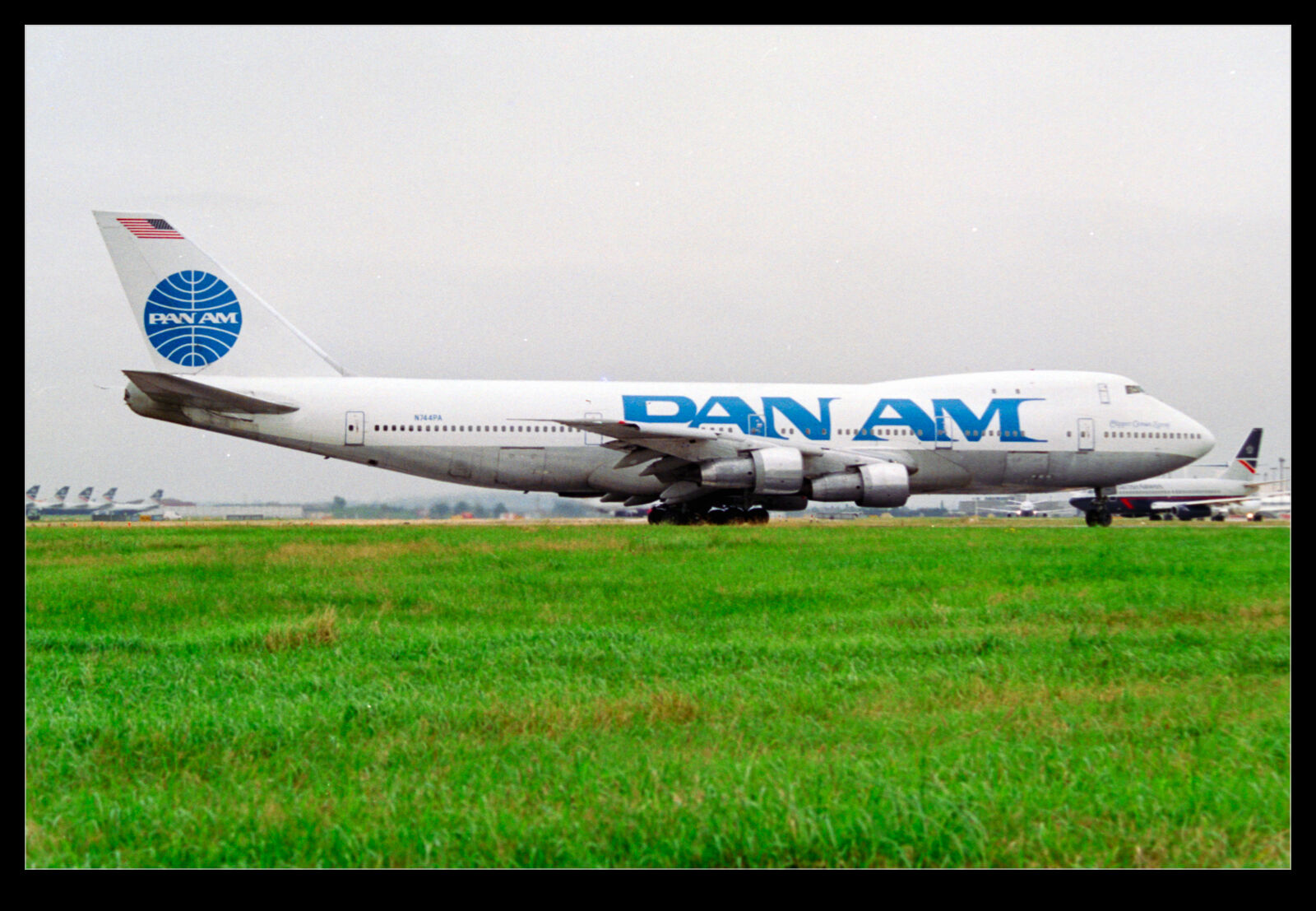
In previous posts I have talked about the program I am going through the scan all of my old negatives and transparencies. It is a far speedier process than I used to use but it is still pretty time consuming and I am about a third of the way through the collection. It will depend on how many rainy weekend days I get as to how quickly I go through them. Something I am discovering as I go is that I have a variety of shots I had completely forgotten about. Over the years I have gone through the sheets of negatives from various aviation events that I wanted shots from. I was pretty familiar with what was there. What I hadn’t realized was that my old film days would often include two or three shots of an aviation topic in amongst a bunch of other shots.
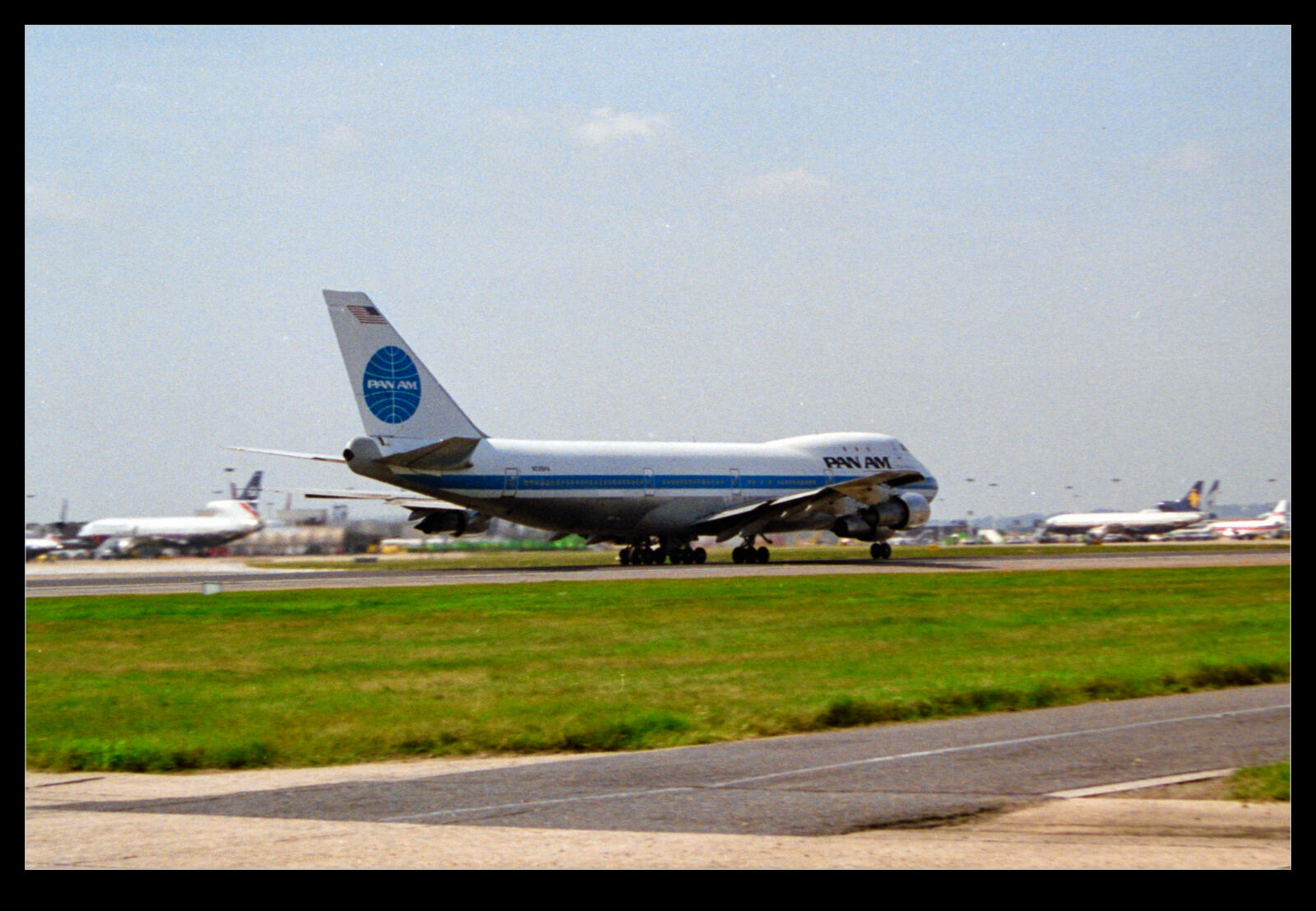
I have been coming across all sorts of shots, both civil and military that I had forgotten about. The majority of them are airliners, some of which are types now out of service and occasionally airlines that don’t exist anymore. Old 747-100s, some early Airbuses, 727 and 737-200, the occasional Ilyushin and even a Shorts Belfast show up. Needless to say there are some appearances by Concorde too.
A combination of poor technique, less than ideal conditions and some less than pristine negatives means that these shots are not going to be gracing the walls any time soon. However, they are an interesting reminder of things that have gone. I wish I had more comprehensive coverage of the time but I actually didn’t take that many pictures at that time. A tad disappointing but I can’t change it now.
Special Liveries
On the whole, airline liveries are getting less and less interesting. Whether it is the branding style, the minimizing of cost or the need to return jets to lessors without too much repainting being necessary, they are ending up a bit dull. However, periodically, an airline will paint one or more of its jets in special color schemes. These may celebrate some event, recall a previous airline that was merged in at some point or be part of an alliance. Whatever the reason, it makes for some variety which is welcome.
I figured I would see which special liveries I have managed to photograph over some time. All of this was prompted by a recent China Eastern A330 that came in to SFO. My friend Roger told me it was coming in which came as a nice addition to the morning. As I was looking at the shots, I started flicking back through the catalog.
I decided not to include the alliance aircraft here. OneWorld, Star Alliance and Skyteam jets tend to be rather similar so I didn’t think they added something special. However, plenty of other jets have been more distinctive looks. It turns out that I have more of them than I realized and I didn’t want to just food this page so maybe I will have another batch of these at some point.
Everyone Has a Trainer Design
The late 80s was a period when a whole bunch of companies were trying to come up with the perfect trainer. A large number of sir forces were considering the replacement of their trainer fleets and much discussion was underway about what the appropriate type of trainer was for the future. Basic jet trainers were ultimately going to be replaced with turboprops in a lot of places but that was in the future. Meanwhile, all sorts of trainer designs were in the works either for the basic training task or for slightly more advanced levels of tuition.
Some of these designs made it to production. Some of them never got beyond the prototype stage. Not all of them went away entirely. Even today you can still see some of the designs in an upgraded and modernized form being pitched at much the same market as they were thirty years ago.
Let’s start with the Redigo. Built by Valmet in Finland, the Redigo was a turboprop evolution of a previous piston trainer, the Vinka. It was seen as a capable but low cost training solution. Finland bought a number although they are now retired. A couple of export customers also took some. Aermacchi bought the rights to the aircraft in the 90s but I haven’t heard much about it since.
The Microjet was a small French design. Powered by a couple of diminutive Marbore turbojets, it produced way more noise than its small size would have suggested. The V tail configuration was distinctive and it made a number of airshow appearances. The project was supposedly driven by Microturbo, the manufacturer of the Marbore engine – presumably to create a market for the engine. It never proceeded beyond the prototype stage though.
Promavia created the Jet Squalus aircraft. Promavia were a Belgian company but the design was originally from Stelio Frati in Italy. Painted in colors that represented Belgium, it showed up at a number of air shows. However, it also never proceeded beyond the prototype stage.
The RFB Fantrainer was a German program. It was a tandem seat aircraft with a ducted fan behind the cockpit. It was designed to provide fighter-like handling characteristics in a training aircraft. It was judged successfully in a competition to provide a trainer for the Luftwaffe but instead they went with a USAF based training program and did not take the aircraft. It was sold to Thailand, though. I don’t know what their current status is. The aircraft was also the basis for a jet powered aircraft offered for the US JPATS competition by Rockwell. However, it lost to what became the T-6 Texan II.
Pulling a Cloud With You
Getting shots of vapor is a popular thing when shooting fast jets. An airliner on a damp day can also result in some clouds being formed. While shooting something special at Oakland, I was getting a few shots to make sure the light metering was working as planned. A Southwest 737 came in and, as it flared for landing, it had a nice cloud of moisture form over the wing. Normally these things pop up further out on the approach and don’t make for a good shot but this one was close at hand.