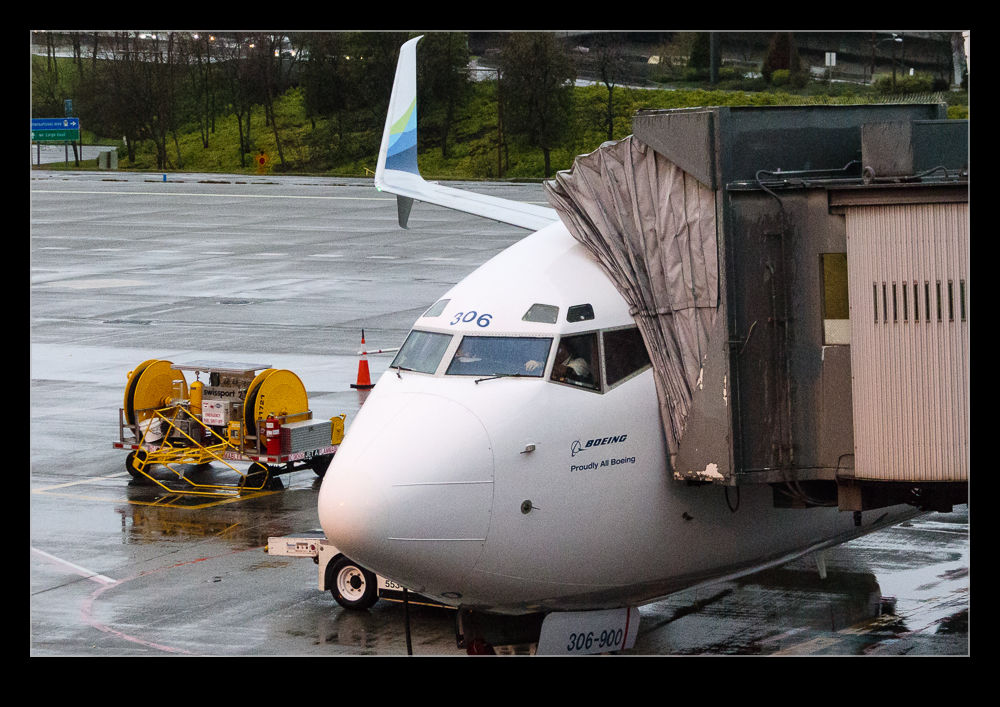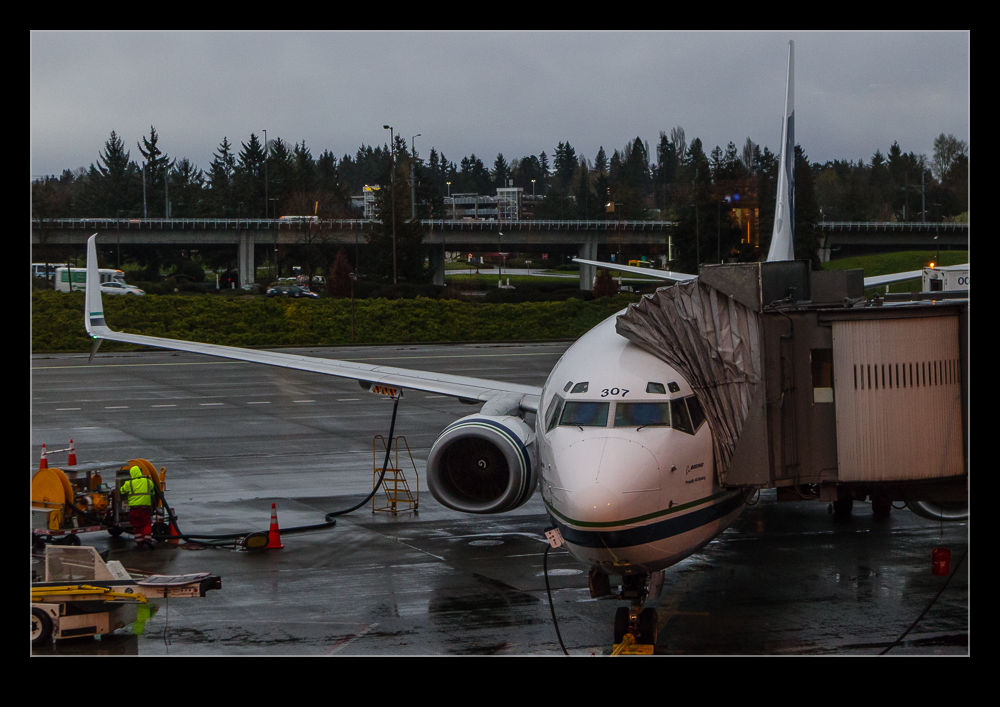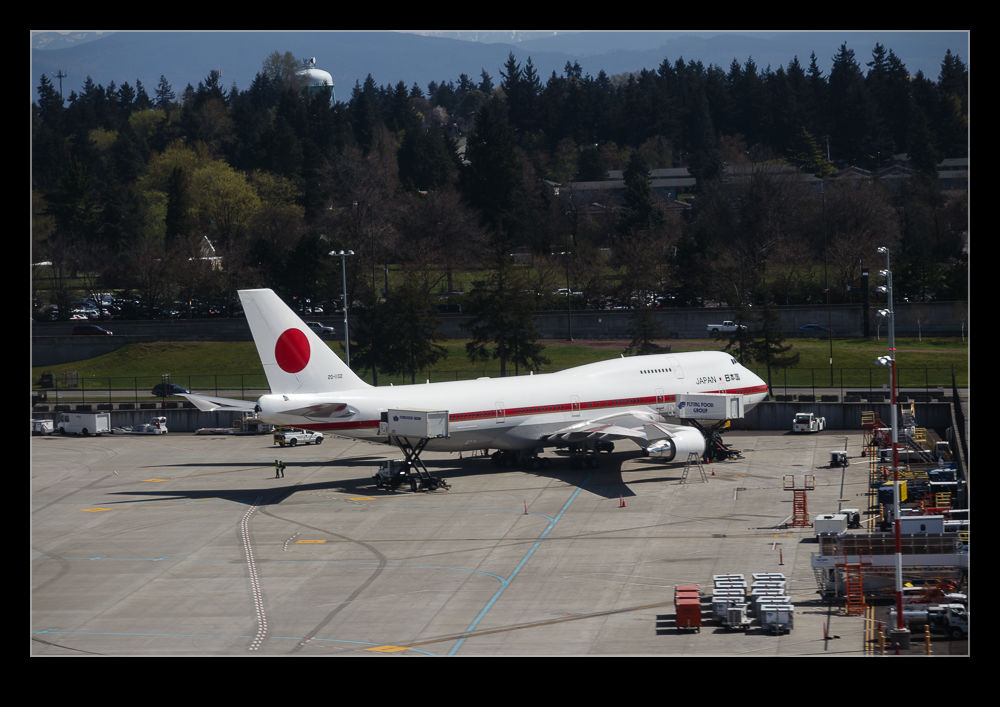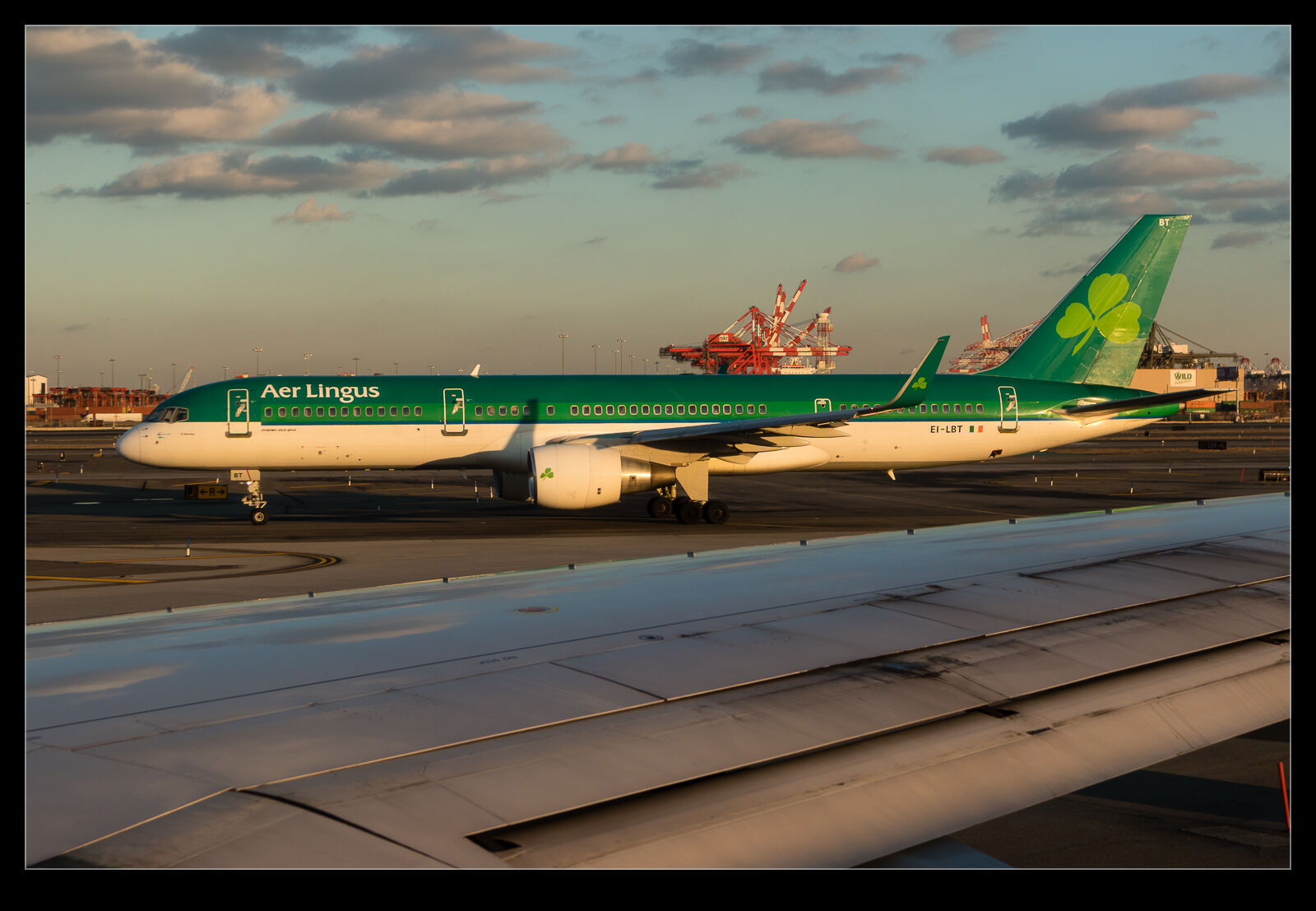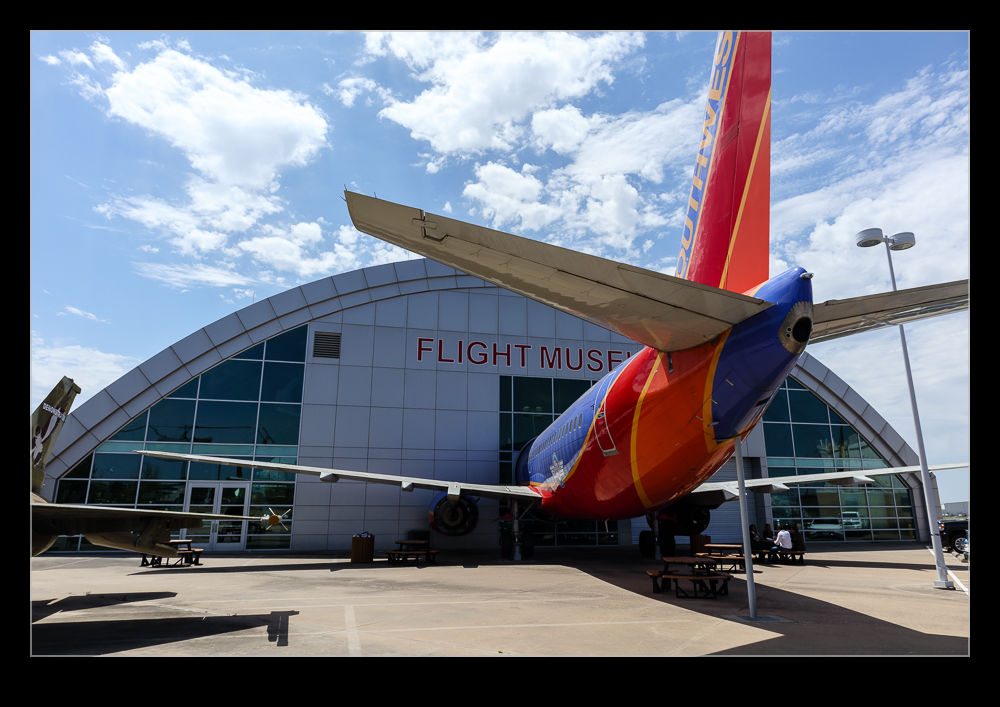
When I watched a Cessna Caravan on floats landing in Vancouver Harbour, I was rather critical of its water handling characteristics. It wallowed horribly and didn’t look like it was supposed to be there at all. However, the Caravan is not a bad plane and it is quite a rugged workhorse so I don’t have a gripe with it per se. Another float equipped example took off from Paine Field while I was awaiting something else and the combination of the afternoon light and the closeness to the plane meant I was rather pleased with the shots that were possible.
Category Archives: civil
Boomer Position in a 747
If you think of aerial refueling tankers, the Boeing 747 is not going to be the first plane that jumps to mind. However, a tanker version of the 747 was developed and is in service to this day in Iran. I haven’t seen one of those planes but, before they were built, Boeing undertook testing of the configuration on their testbed, the original 747 prototype. This is on display at the Museum of Flight in Seattle. When we were walking through the fuselage, we got to the read and found the boomer station. Apparently, it was not removed after installation. It looks remarkably similar to that from a KC-135 so I guess they ported the design across rather than come up with something significantly different.
Trailing Static Cones
For the people that don’t care for my aviation posts, this one won’t be of interest. For the aviation fans that don’t care about the techie stuff, this will also be of limited interest. That probably leaves a very small group of readers by now (Gary, I am trusting you are still here). This is about a piece of flight test instrumentation that often causes questions when people see it. It is the trailing static cone.
The aircraft has sensors that measure air data, two of the most important of which are the pitot probe and the static port. The pitot probe measures the dynamic pressure of the air which increases as the speed increases. The static port measures the air around the aircraft. The difference between the two is used to determine the speed of the aircraft and the static is used to determine the altitude. These are both vital information for a pilot. However, the aircraft affects the flow of the air around it so, while you can calculate what the pressures should be, you need to validate what the actual readings are. The first flights are carried out prior to calibrating the system so you need to have a bit of margin in the speeds you use until you have confidence in the readings.
Measuring static pressure is hard to do. The plane will have a static port on the skin of the plane as well as possibly incorporated with the pitot head. However, the air has accelerated to go around the fuselage so it is assumed to have a lower pressure than ambient. Because the plane is disturbing the flow, you need a way to measure the pressure some distance away from the plane. The answer is a trailing static cone.
This cone incorporates pressure measurement sensors and it attached to a long cable. This is held on a reel inside the aircraft and fed out of the aircraft at the rear. For airliners, this is usually through a modification to the top of the fin. A comparison between the test aircraft and a production jet will show the different structure. The cable dangles out of the fin and, as the speed increases, the cone pulls the cable taught and streams backwards.
When the testing is required, the cable is winched out and the cone is a long way behind the aircraft in what is relatively undisturbed airflow. If you go to the Museum of Flight, the prototype 747 is on display and it includes the trailing cone equipment in the fuselage. The reel is shown in its mounting location and the trailing cone is hung inside to allow you to take a look at it.
Two Avantis in One Go!
Not long ago, I posted about seeing an Avanti for the first time in a while. The lack of Avantis having been broken, I have seen a couple more. I saw that one had come in to Boeing Field and I was there before it fired up for its next flight. It taxied out on the opposite side of the field and then took off to the northeast.
A short while later, I saw a silhouette of a plane on approach and looked closer to see what it was. It looked pretty like an Avanti so I figured it was the same aircraft returning for some reason. I was a bit bothered that something might be wrong but happy to get another chance to shoot it. As it got closer thought, it was clearly not in the same paint scheme. Instead, it turned out to be a Canadian registered example and a pretty nice looking one at that.
Getting two Avantis within a short space of time was an outcome I was pretty pleased with. Unfortunately, I couldn’t hang around to get the departure of the second example.
Korean Air Dreamliner on Test
I had a couple of encounters with the same jet while it was on test. (It’s brake dust already showed up in this post.) This 787-9 is, by now, part of the Korean Air fleet. I saw it depart from Paine Field one evening in pleasant light. The low sun angle really brought out the shape of the underside of the wing in a way that normally you just don’t get to appreciate. It showed up a second time while I was out to get the farewell flight of the Delta 747 which I wrote about here. It came in at a similar time and the wet weather helped to make the pale blue color scheme pop a bit more.
One More Chance With Virgin’s A340s
Substitutions on the Seattle route are not just limited to Lufthansa. Virgin Atlantic has been flying the route with the 787-9 but, as with a lot of the Rolls Dreamliner operators, Virgin has been suffering from engine shortages while the blade cracking problems are dealt with. They have brought the A340-600 on to the route in the interim. I thought I wouldn’t be seeing these again after the last examples at SFO I saw but I got another chance. Not great light but it was good to see one more time.
Two More 737s Heading to Renton
At various times I have seen the fuselages for new Boeing 737s heading by on the trains through Seattle. Usually I am a distance away from them and I get a shot that is a bit hazy and less than distinct. Recently I was working in a yard alongside the main tracks as some equipment was being loaded. I had my camera to hand to record the loading process as a train came by behind us. Initially I figured it was just another freight train so didn’t pay attention. Then, I caught the color of the fuselages out of the corner of my eye and realized a couple of new jets were onboard. Before it got too much further, I was able to grab a couple of shots.
Lufthansa Retro Jet
Lufthansa have painted up one of their 747-8I jets in a livery that is based on their old color scheme. Until recently, the Seattle route was being flown with a 747-400 so I didn’t anticipate the chance to see it. Then, in the aftermath of the Air Berlin bankruptcy, Lufthansa deployed some 747s on domestic services to bolster capacity. This meant some 747-400s were pulled from routes and the 747-8I was subbed on to Seattle. I was down there on a crummy day to get the IL-76 and the special jet was due in. I figured I couldn’t miss it, even if the conditions weren’t great. The light was not great as it came down the approach but the shot from behind as it got to the threshold was a bit better.
Filming With a G650ER
I missed the best of this event. I got to Everett towards the end of a filming session with a Gulfstream G650ER jet. An Astar was being used to film the jet as it flew some approaches. I had actually noticed the jet online earlier in the day because it had been flying orbits over some of the islands and showed up on FlightRadar24. I didn’t know what it was at the time but, once I got to Everett it all became clear. I didn’t get anything of the Astar as I didn’t have the camera out when I first arrived but I did get a shot or two of the Gulfstream near the end of the flights. Looked like a fun sortie to be involved with.
Qatar Cargo Recycles the Seahawks 747-8F
Boeing announced the sale of a couple of 747-8F freighters to Qatar Cargo and then immediately delivered one of them. I was confused at the time as I thought it would be a while before the deliveries took place, but it turned out that they had sold a couple of jets that had been previously built but had not been delivered. The second of the jets was recently in flight test. This jet is quite well known as Boeing had painted it up in Seattle Seahawks colors for a Super Bowl appearance and then for a few follow up flights. Now it has been repainted and, when I shot it one weekend afternoon, it was close to being ready for delivery.