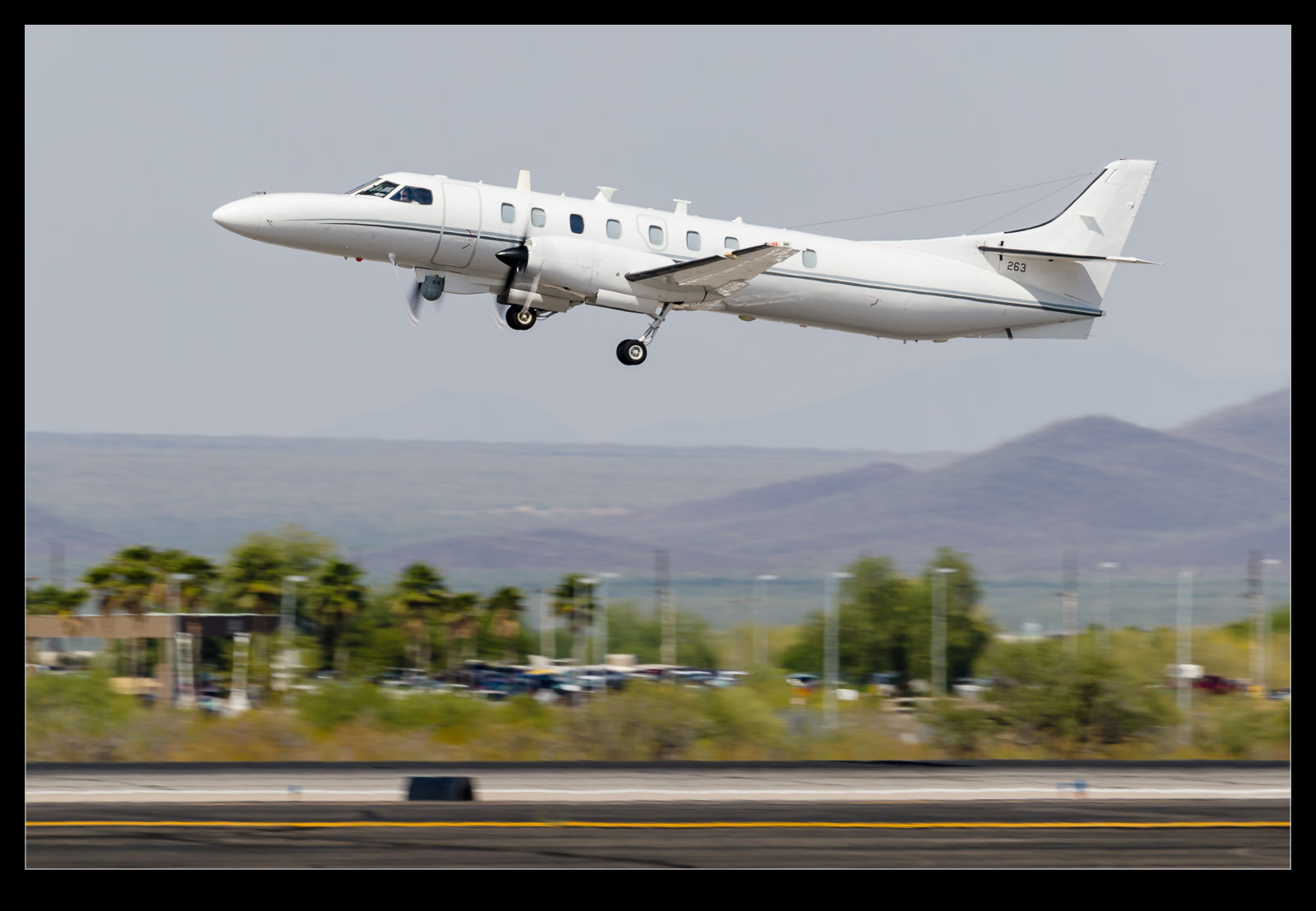
A number of different airframes have been used for airborne early warning requirements. The Boeing E-3 Sentry is the most well-known but there have been a number of other types over the years. SAAB developed a radar system that has been mounted on Embraer 145 jets, SAAB 340s and SAAB 2000s. The development of this system was started in the 1980s and a testbed was produced prior to the system appearing on a production airframe. This testbed was a Fairchild Metro turboprop. It made an appearance at the Farnborough airshow where I got some shots of it. It was camouflaged in what was then the standard Swedish camouflage scheme. This was a cool look for their planes and I do miss it.
Category Archives: military
Iraqi F-16s
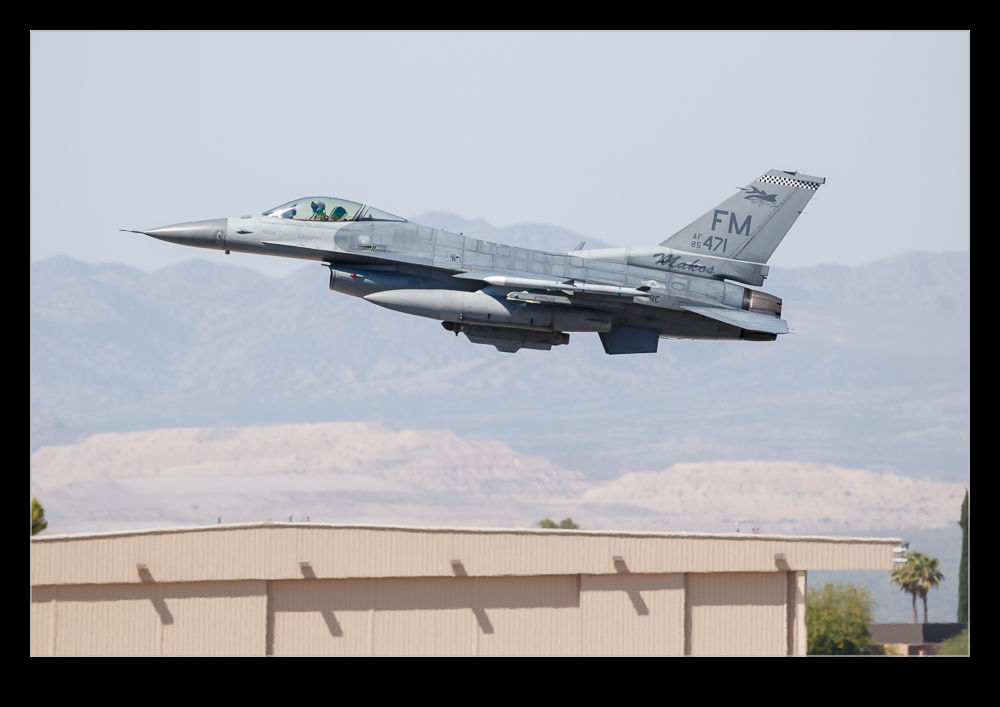
Iraq places an order for F-16s a number of years ago. The first aircraft were not initially delivered to the country but instead went to Tucson to set up a training unit. There are still some aircraft there being used to train new Iraqi pilots. Soon the remaining jets will head to Iraq following those that have already been delivered. I hadn’t seen them before since this all happened since my last visit to Tucson. They operate from Tucson International, alongside the ANG unit and the Dutch training unit.
We had a few movements of the Iraqi jets while I was there and these were, apparently, some of the newer jets to have been delivered. They have adopted a different camouflage pattern to the normal F-16 scheme so it is easier to recognize it is them as they approach. I doubt I will be back before they leave the country so this was one of the few times I will likely see these jets.
- An Iraqi Air Force Lockheed Martin F-16C Fighting Falcon takes off from Tucson International Airport in Arizona.
Transport for the Hawgs
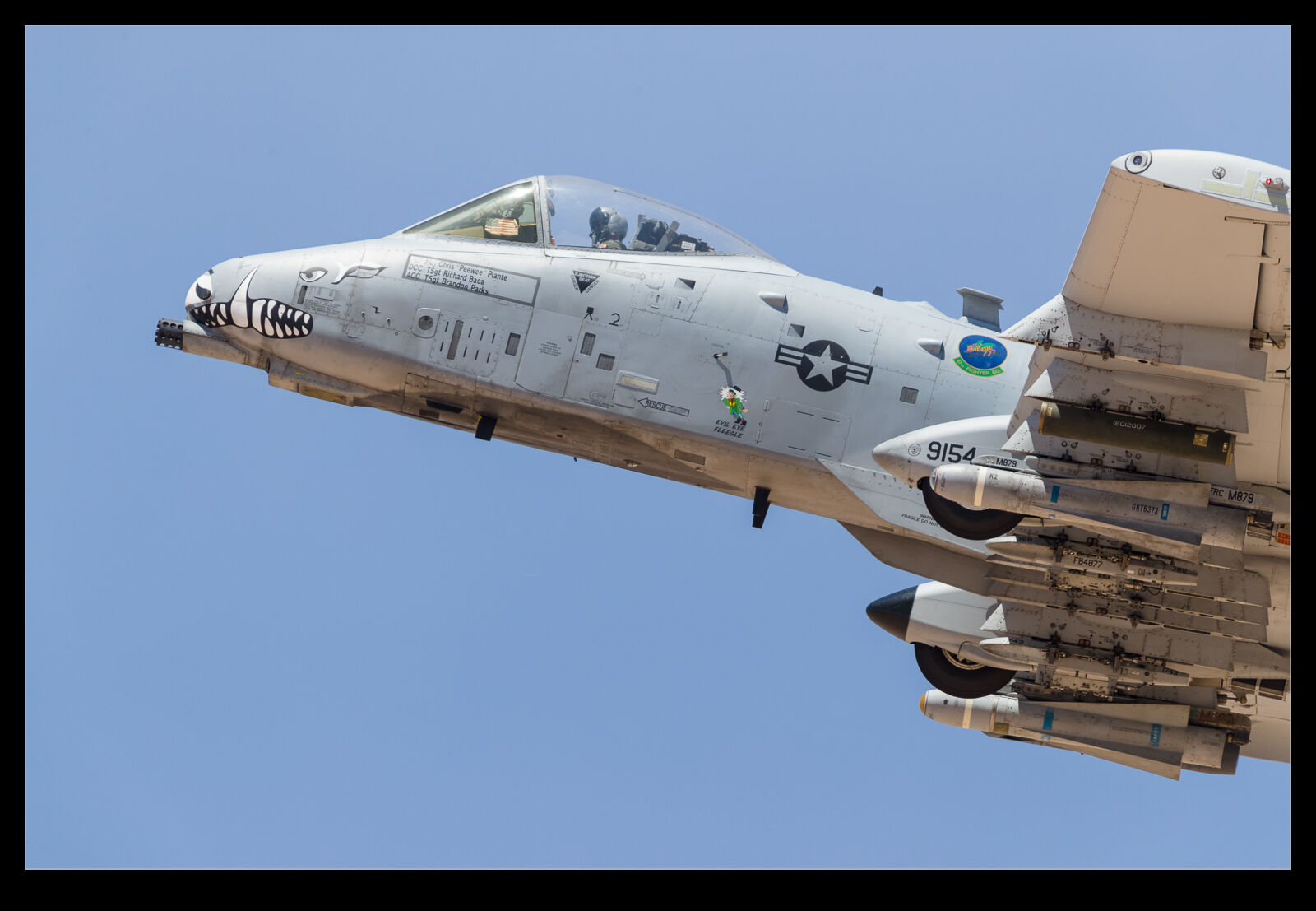
All of the A-10s coming in for Hawgsmoke need some support. There were C-17s and C-5s on the ramp during the exercise. While we were out watching the jets arrive, a C-130J came in as well. It landed and then turned to taxi right back passed us. I don’t know for sure whether it was supporting the A-10s from a unit or it was just a coincidence that it arrived at that time on another mission but I figure that it is a strong chance that is why it was there.
DM’s Museum Jets
Many airbases have a selection of historic aircraft on display to show something of what has gone before on the base. Sadly, they are often unavailable to shoot when you visit. Davis Monthan AFB has quite a few different planes on display and, fortunately, the location of the Fallen Hawg ceremony during Hawgsmoke was in front of the display A-10. While everything was being set up, we had some time to kill and I was allowed to wander around the other planes.
The selection included some obvious DM aircraft like the A-10 and A-7 (even if it was actually a Navy A-7E that they had repainted). A U-2 was a slightly more surprising one to see. I’m not sure how that qualifies but I wasn’t complaining. The F-105, F-100 and F-4 all looked good too. Not only was it nice to be able to shoot them but it gave us something to do since we had got in place pretty early!
Vampires Out in Daylight
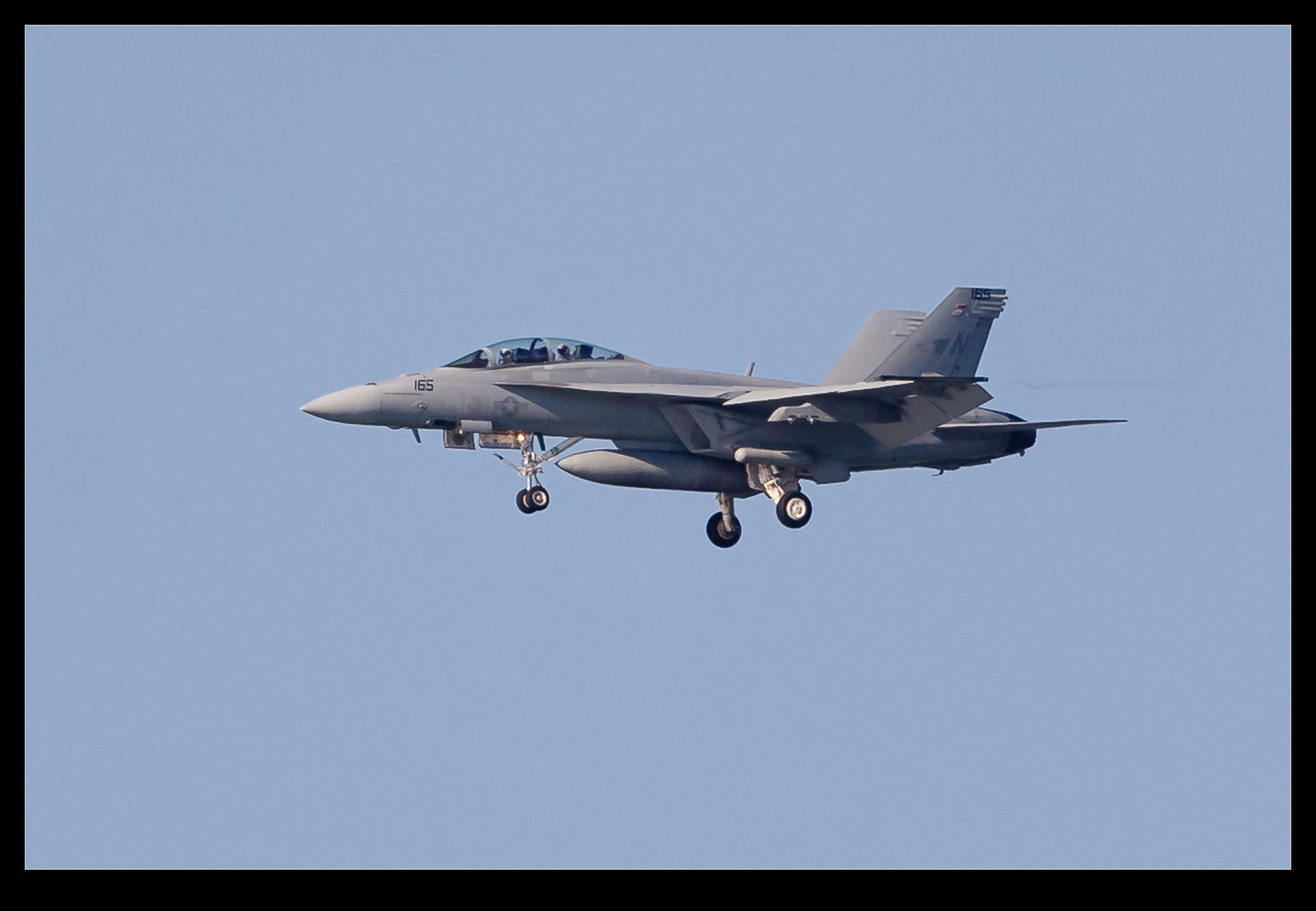
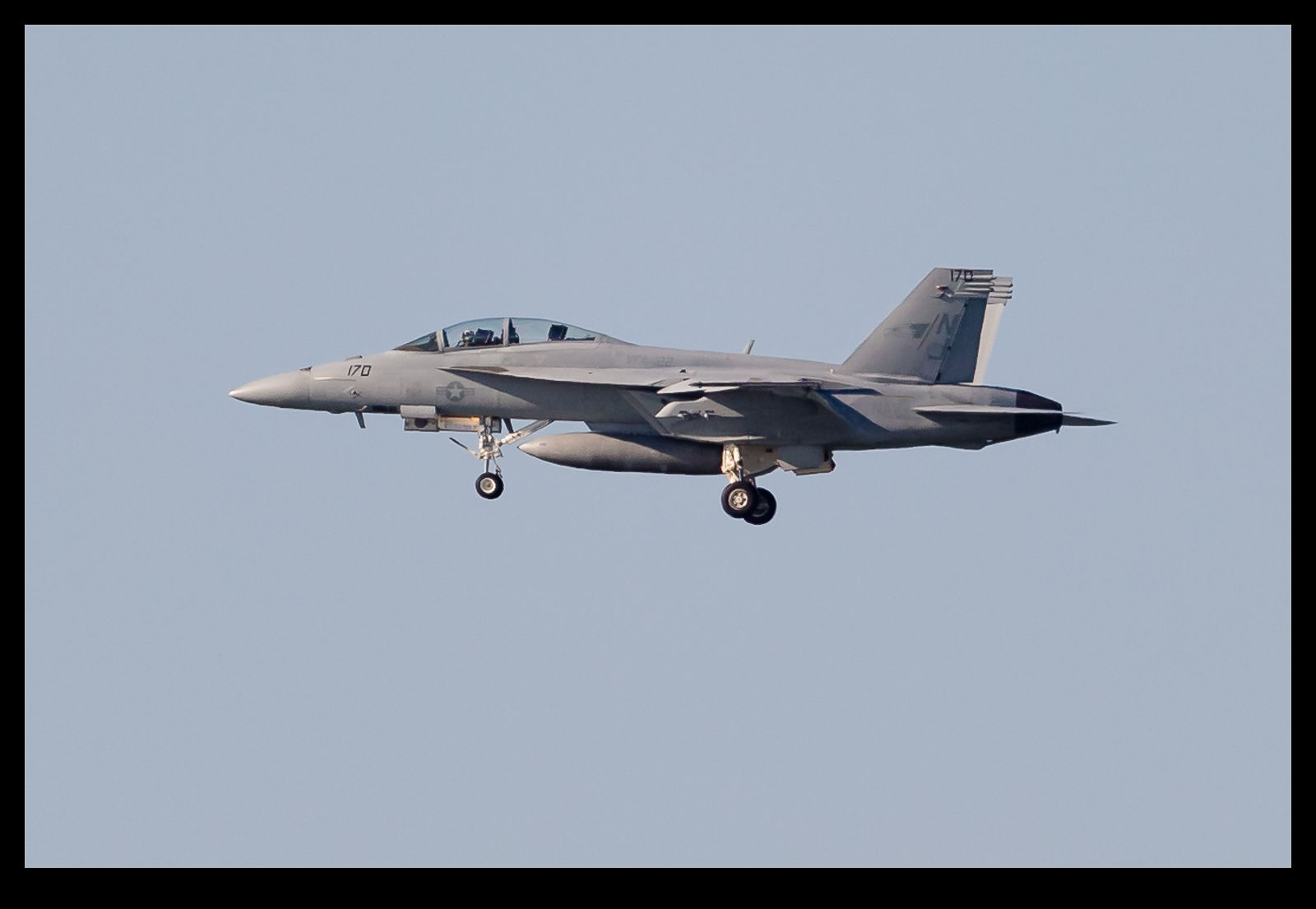
Tucson International is a place I was expecting to shoot F-16s of various nations. I had not expected to see any Super Hornets. However, the Navy had other plans. A couple of VX-9 Vampires jets were detached and carrying out missions with some of the based test aircraft. One of them was the color jet too! This was a very pleasant surprise. They took off in the morning for a mission and we got to see them head off. They returned ahead of my expectations and I wasn’t in the right place to get them on approach. Even so, a great addition to the day. I was flying home later that day and, while looking out of the window at the gate, they taxied by again so I guess they were getting a lot of flying in.
French Gazelle
Chino is full of surprises. There are many hangars and many unusual things contained in them. A friend showed me a shot of a Jaguar T4 that was in one of them – I was disappointed to not see that myself. As I was walking back towards the parking with a fellow shooter, we came across a hangar with a Gazelle in it. The guy cleaning out the hangar floor invited us in. It was a French Army Gazelle, still equipped with many electronic boxes from its military role and showing the mounting point on the side of the fuselage where HOT anti-tank missiles were once mounted. He flies it regularly and says it has been immaculately maintained over its service life. It certainly looks great.
Mustang Motion
The Society of Aviation History visit to Airmotive Specialties in Salinas gave us a great opportunity to look around the restoration facility. One of the Mustangs was not being worked on though. It was due to be picked up by its owner that afternoon. As a result, having had a break for lunch, we headed back to the ramp to await the departure.
The aircraft was run up on the ramp outside the hangar and then taxied to the opposite end of the runway for takeoff. We anticipated the takeoff and then a further pass before he left. I figured the first time I might go with a slow shutter speed for fun. The second one I would be a bit more conservative in order to make sure I actually got a sharp shot.
After the two passes the aircraft headed off en route. Getting a bit of airborne Mustang time was a cool addition to a great day.
Marineflieger Tornado
Tornado was a tri-national program. The UK, Germany and Italy were the partners that developed and produced the aircraft. There was only one export customer which was Saudi Arabia. All of the users continue to operate the aircraft although all of the ADVs have now been withdrawn. Germany took a substantial number of the jets but, while the Luftwaffe remains a major user, it is easy to forget that they were not alone.
The German Navy had a fast jet fleet. The Marineflieger operated the F-104 in large numbers and these were replaced by the Tornado. Originally, they were in the Blue/gray upper fuselage with white undersides colors which looked very neat. Later on (including the time this photo was taken), they had migrated to a camouflage scheme. Then, a consolidation exercise took place and the Navy jets were transferred to the Luftwaffe which took over their responsibilities.
Airmotive Specialties Visit
The Society of Aviation History organized a visit to Salinas to the facility of Airmotive Specialties. Owned and run by Dave Teeters, Aviation Specialties provides a number of services but the thing that brings them most attention is the restoration of warbirds with a strong focus on P-51 Mustangs. During our visit, there were seven Mustangs in the hangar in various states of restoration. There were some other types too as well as some more commonplace types undergoing maintenance.
Dave has spent his life in this business having started working for his Dad before setting up on his own. He supplies parts to his Dad’s business and vice versa as they both operate in the same field. Dave has really committed to the processes and capabilities needed to restore these vintage aircraft. His team is one that he has trained and many of his staff have been with him for years. He has also invested in technology. So many parts for these aircraft are hand crafted but Dave has acquired numerically controlled machines to assist in producing a large number of components. These machines are also capable of digitizing the outline of existing components to allow him to reproduce them as needed.
The investment in these machines is substantial but the pay off comes in how quickly he can produce replacement parts once the process is done. Hand crafting these parts is an intensive business and, when sufficient are needed, the business case is straightforward. Even so, there are still many pieces that require the hand skills that are in short supply and are becoming rarer. Dave maintains capabilities with many old tools and techniques in order to make sure that they can always provide what the customers need.
The hangar was full of interesting projects in various states. Some were disassembled completely with rework on fuselages and wings plus various subassemblies. Others were fully complete and were just in for ongoing maintenance. A great looking Beech 18 was at the front of the hangar along with a P-51 due to be picked up by its owner. A couple of Robinson R44s were also parked in with a JetRanger – one of the R44s flew off later in the day.
Dave provided great access to our visit and was exceedingly generous with his time. He explained exactly how they work and answered any questions the group had for him. The hangar has some nice facilities for customers but, while they were very comfortable, the contents of the working area were of most interest to us and Dave gave us freedom to wander as we wished. It was a great time. Many thanks Dave.
Rafale A Demonstrator
The Dassault Rafale is a fantastic looking aircraft. Gradually being built in reasonable numbers, it has broken into the export market and has customers in Egypt and Qatar and probably India although exports to India are always hard to pin down! The French air force and navy will no longer be the sole operators. The Rafale B is a two seat version and the C is the Air Force’s single seat version. However, there was the Rafale A. One of them was built in the mid 1980s as a demonstrator. It looks almost identical to the production version but was actually slightly larger. Painted in Dassault’s house colors, it made a number of air show appearances. At the time, it was competing for attention with BAe’s EAP demonstrator. I didn’t get to see EAP until I got to Warton where I wasn’t able to photograph it!
Here are some shots of the Rafale A. It was originally powered by GE F404 engines although later one was swapped for the M88 that would power the production Rafale. The first Rafale C was rolled out in an all black paint scheme which made it look very cool. The size difference is not immediately obvious but a number of detail design changes were incorporated too including lots of sensors required for an operational type rather than the demonstrator. The wing planform was also altered slightly based on the experience gained with the demonstrator. I understand that, when the aircraft was retired, it went to the Museum at le Bourget in Paris.